Dr.-Ing. Philipp Johst
Research Assistant
Team: Chair of Composite Lightweight Engineering | Prof. Dr.-Ing. habil. Robert Böhm
Group Leader: Composite Circularity Lab
Publications: ResearchGate
Career: LinkedIn
Telephone +49 (0)341 3076 4243
Send an email | philipp(dot)johst(at)htwk-leipzig.de
HTWK Leipzig | Faculty of Engineering
Nieper Building | Room NI435
Karl-Liebknecht-Straße 134, 04277 Leipzig
Memberships
- Member of the Circular Wind Research Network (CWRN) (Link: https://www.linkedin.com/groups/12971002/)
Teaching
- Supervision of project work, Bachelor’s and Master’s theses as part of research projects
Bachelor’s degree programmes
- Lightweight Construction Technologies
- Design of fibre-reinforced composite components
Master’s degree programmes
- Polymer materials/fibre-reinforced plastics
- Lightweight Structures
- Multifunctional lightweight structures
Research
- Experimental and numerical analyses of multiple-impact problems in fibre-reinforced lightweight structures
- Destructive and non-destructive testing methods for the material characterisation of fibre-reinforced composites
- Thermal analysis methods for polymers
- Evaluation and interpretation of acoustic emission data using advanced methods
- Numerical analyses using FEM (software: ANSYS)
- Recycling and circular economy concepts
Industrial operations
- Process optimisation of the front-end pre-assembly line at the BMW plant in Leipzig
- Supervision of testing processes in the ABSOLUT II project
ReComCret
Methods for the reuse of end-of-life composite components in the construction industry
Through interdisciplinary collaboration between the fields of wind energy, construction and lightweight construction, ReComCret aims to develop a system-oriented, holistic approach to the production and reuse of end-of-life (EoL) composite components from wind turbine blades (WTB) for applications in the construction sector in the form of glass fibre-reinforced concrete, and to develop this into a market-ready product. The chosen approach aims to avoid the environmentally harmful disposal methods of incineration and landfill in future and, instead, to achieve a circular economy approach to the use of fibre-reinforced composites from the wind energy sector.
Funding: SAB/EU
Project duration: 03/2026 – 04/2028
RecyRotor
Development of a scanning and separation process for the recycling of wind turbine rotor blade structures through repurposing
The aim of the RecyRotor project is to develop mobile analytical equipment and a process chain for the secondary recycling of rotor blades from wind turbines once their primary service life has come to an end. To this end, HTWK will investigate damage patterns in end-of-life rotor blades, taking into account the load history of the components, using mechanical and optical methods.
Funding: ZIM
Project duration: 01/2025 – 06/2027
ValidFloatingPV
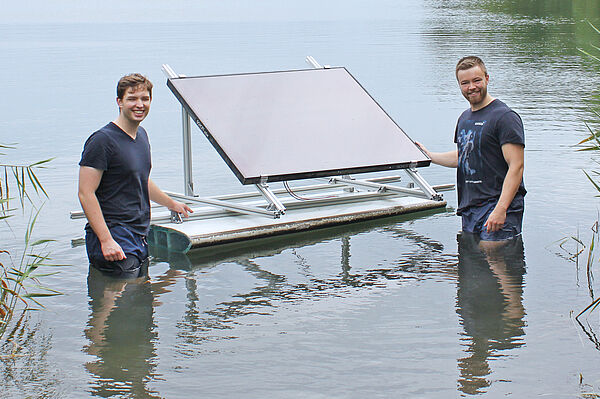
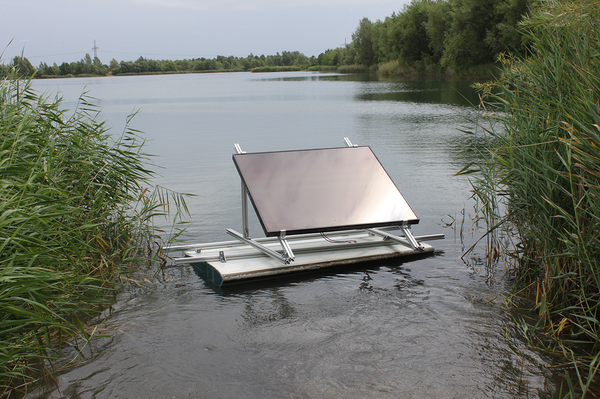
The project involves the development of a large-scale demonstrator for floating solar power systems (floating PV) using floats made from end-of-life rotor blade segments. Such floating PV systems can be used efficiently to generate electricity on unused bodies of water. The project lays the foundations for a spin-off company specialising in the manufacture and sale of products made from reused rotor blade materials. It involves collaboration with Startbahn13, the start-up consultancy at HTWK.
Funding: SAB
Project duration: 01/2025 – 05/2026
EuReCOMP
European recycling and circularity in large composite components
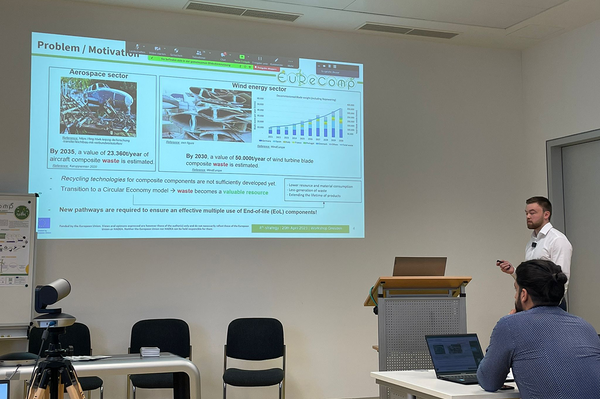
EUReCOMP aims to provide sustainable methods for the recycling and reuse of composite materials derived from components used in various sectors, such as the aerospace and wind energy industries. The key approaches to achieving this in line with a sustainable circular economy are: i) the repair, reuse and redesign of components from end-of-life mass-produced products, and ii) the recycling and recovery of the materials used in these components. This reduces the volume of waste and enables the transformation of materials into high value-added products.
Funding: EU Horizon Europe
Project duration: 04/2022 – 03/2026
EnamiPro
Experimental and numerical analysis of multiple-impact problems in fibre-reinforced lightweight structures
For fibre-reinforced composites used in safety-critical structural components, such as in the automotive industry or in aerospace, so-called safety verifications must be carried out. Impact and crash loads often result in the most critical load cases, meaning that calculation procedures and simulation methods tailored to the specific materials are required. Describing multiple, sequentially occurring crash and impact events presents a particular challenge, which is being investigated experimentally and numerically in the Enamipro project.
Funding: SAB
Project duration: 04/2021 – 03/2022