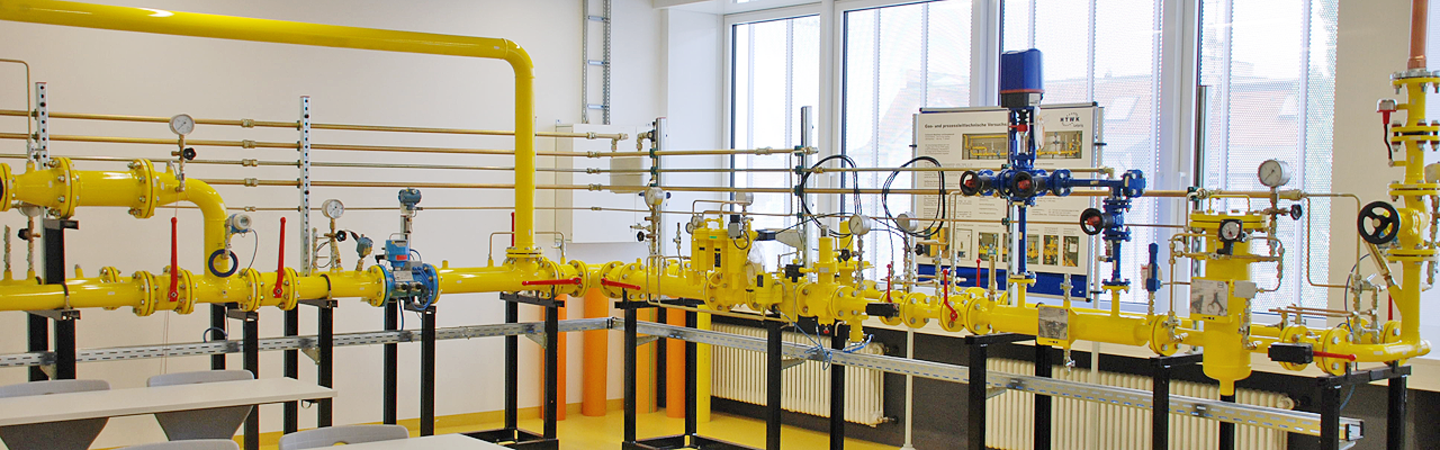
Practice in Gas Supply Technology
Objective
To familiarise oneself with the function and operation of gas-related systems
Key training areas
- Design and components of a gas pressure regulation system
- Design, function and response characteristics of safety shut-off valves (SAV) and safety relief valves (SBV), as well as gas pressure regulators
- Measurement and control technology in gas supply systems
Practical sessions | Structure and operation of a dual-line gas pressure regulation and measurement system, and determination of the closing pressures of safety shut-off valves (SAV) and safety relief valves (SBV)
Aim of the experiment
- Explanation of the components of a GDRA/GRDM
- System design in accordance with DVGW G 491
- Familiarisation with safety-related components
- Measuring the response pressures of the shut-off valves RMG 711, RMG 720 and RMG 330 and the blow-off device RMG 835
- Production of pressure gradient diagrams
Practical sessions | Determining the Joule-Thomson effect for various operating conditions
Aim of the experiment
- Determining the temperature drop at different flow rates Comparing the Joule-Thomson coefficient for air with that of other gases and at different gas pressures
Practical sessions | Determination of operating and standard volume flow rates for variable load requirements
Aim of the experiment
- Analogue and digital measurement of operating volume flows
- Calculated and digital determination of standard volume flow rates
- Creating and analysing a flow rate diagram
- Measurement and analysis of flow-induced noise levels
Practical sessions Demonstration practical session on a pigging system
Aim of the experiment
- Explanation of the design of cleaning and inspection pigs
- Possible applications
- Understanding how pigging systems work