Prof. Dr.-Ing. Hendrik Richter
Institute
MSR | Institute of Measurement and Control Engineering
Research profile
Robotics, Control & AI
Contact
Room: WI14.1
Phone: +49 341 3076 1123
Send e-mail | hendrik(dot)richter(at)htwk-leipzig.de
Publications ResearchGate | GoogleScholar
Member of conference committees (PDF)
Career Wikipedia
Teaching
Bachelor's programme
- Control Engineering and Simulation Technology
- Control Engineering 2
- Digital and discrete-event control
Master's programme
- Control Theory - Nonlinear Control
- Nature-inspired methods of computer intelligence
- Stochastic and model predictive control
Research
- Analysis tools and control design of nonlinear systems
- Metaheuristic methods: biology-inspired problem solving, evolutionary algorithms and evolutionary game theory
Awards
- EvoMusArt 2018, Parma, Italy: Best paper award nominee. Visual art inspired by the collective feeding behaviour of sand-bubbler crabs.
- IEEE WCCI 2016, Vancouver, Canada: Regular best paper award. Analysing coevolutionary games with dynamic fitness landscapes.
- EvoComplex 2012, Malaga, Spain: Best paper award nominee. Analyzing dynamic fitness landscapes of the targeting problem of chaotic systems.
Functions | Memberships
- Institute Spokesperson MSR Institute for Measurement and Control Engineering (since 09/2024), Faculty of Engineering, HTWK Leipzig
- Member of the extended Senate of HTWK Leipzig
- Member of the Examination Board of the Faculty of Engineering, HTWK Leipzig
- Member of the Faculty Council of the Faculty of Engineering, HTWK Leipzig

Tutorial | Game dynamics on evolutionary graphs - An introduction
Upcoming: IEEE Congress on Evolutionary Computation 28.06-1.07.2021 Kraków, Poland (VIRTUAL)
The tutorial will give an overview about concepts and research questions as well as addressing recent developments in studying evolutionary games on graphs. Particularly, the concept of game dynamics with changing strategies and interaction networks is addressed.
Tutorial: Game dynamics on evolutionary graphs - An introduction

Alife 2020 Talk
Generating symmetry and symmetry breaking in sand-bubbler patterns
We study creating and breaking symmetry in digitally gene-generated artificial-life-based visual art. Therefore, an artificial swarm-based pattern-making system is used as a test bed. The patterns are generated algorithmically by emulating the collective feeding behavior of sand-bubbler crabs. Our fo-cus is on analyzing concepts and templates for incorporating symmetry and broken symmetry into the creation process of bioinspired art. All four types of two-dimensional symmetry defined by isometric maps are used to create images. Apart from treating geometric symmetry, we also consider colour as an object of symmetric transformations. Color symmetry is realized as a color permutation consistent with the isometric maps. Therefore, color permutation groups have been de-signed which utilize mappings on a color wheel.
Generating symmetry and symmetry breaking in sand-bubbler patterns (PDF)
Alife 2020 Talk (Youtube-Video)
Sand Bubbler Art (Youtube-Video)
Tutorial | Recent Advances in Fitness Landscapes
IEEE World Congress on Computational Intelligence (IEEE WCCI), Beijing, China, 2014
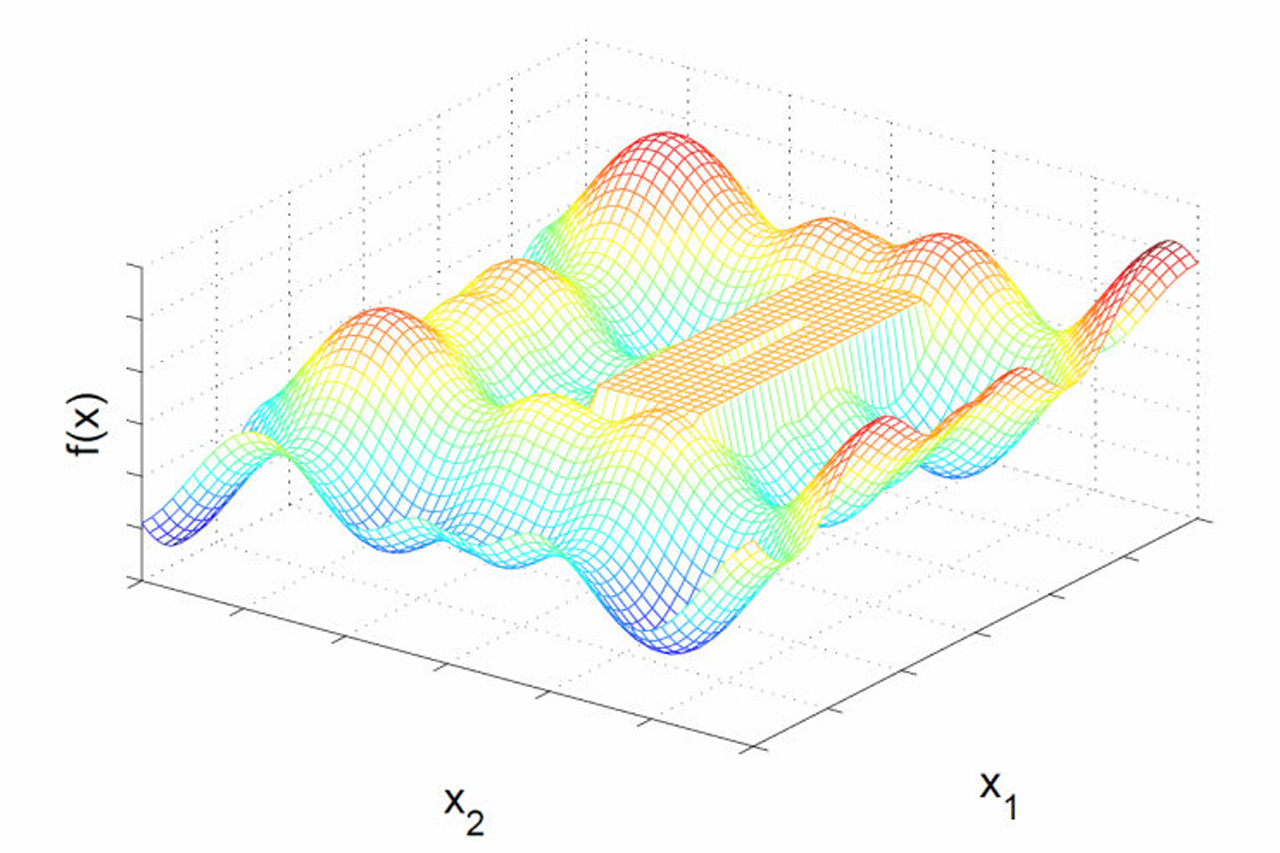
Fitness landscapes are an abstract way for describing the relationship between the genetically possible (genotype), the actually realised (phenotype) and the survival/reproduction success (fitness). In other words, fitness landscapes are about analysing and visualizing the relationships between genotypes, phenotypes and fitness, while these relationships lay at the centre of attempts to mathematically describe evolutionary processes and evolutionary dynamics.
The tutorial will cover the following topics.
- Principles and perspectives of fitness landscapes
- Examples of empirical and computational landscapes
- Topology, measures and problem hardness
- Coevolutionary and dynamic fitness landscapes
- Open questions and research topics
Tutorial Recent Advances in Fitness Landscapes
Recent Advances in Fitness Landscapes (PDF)
Tutorial | Concepts and recent results in coevolutionary games
IEEE World Congress on Computational Intelligence (IEEE WCCI), Rio de Janeiro, Brasil, 2018
Studying evolutionary and coevolutionary games can be seen as an attempt to address a long-standing and fundamental problem in Darwinian evolution. How can the two seemingly contradictory observations be reconciled that individuals experience selective pressure which entails competition in order to be successful in survival and reproduction, but at the same time there is wide-spread cooperative and even altruistic behaviour between individuals (and also groups of individuals or even species)? In other words, how can we have selection that favours fitter individuals over less fit, while the same individuals regularly cooperate with and support each other, thus ostensibly leveling off differences in fitness?
Tutorial Coevolutionary games
Concepts and recent results in coevolutionary games (PDF)