Heating tower test rig
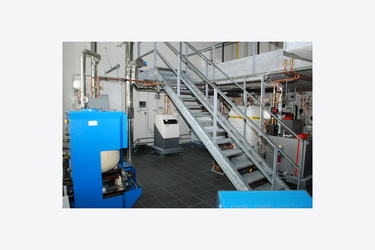
With its three levels, the heating tower resembles a real building or an actual plant. This enables students to quickly, easily and effectively grasp the structure and function of a pumped-storage hot-water heating system. The knowledge of safety engineering taught in theory is applied to various heat generators (gas and oil boilers, pellet boilers, low-temperature and condensing technology, CHP units, heat pumps).
Students identify the safety-related components and are able to test their function. Efficiency tests are to be carried out on selected heat generators. Pipes, laid in a clearly visible manner, connect the heat generator system (including buffer tanks) to the radiators (panel radiators, towel radiators), underfloor heating and wall-mounted heating elements located on the upper floors. The system’s hydraulics must be calculated as the basis for pump sizing. The effect of hydraulic balancing is visible via integrated transparent impellers.
Heat pump test rig
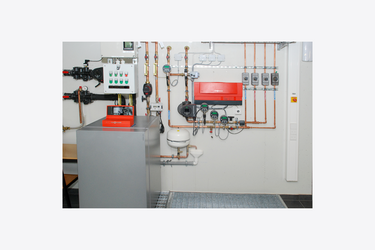
Following a discussion of the various heat sources and an illustration of the differences in the design of air-source and brine-water heat pumps, measurements are carried out to determine typical parameters. For this purpose, a so-called Helix probe (5 m borehole depth; 40 m PE pipe 25 x 2.3 mm), an energy pile (borehole depth 10 m, 60 m of PE pipe 20 x 1.9 mm) and a deep borehole (borehole depth 99 m, 200 m of PE pipe 32 x 2.9 mm).
Using these heat sources, the cooling capacity absorbed by the evaporator, the heating capacity discharged by the condenser and the compressor capacity are determined during the operation of real heat pump units. The process is plotted on a log p-h diagram. Enthalpies and heat quantities are calculated. Furthermore, the Carnot coefficient of performance, the coefficient of performance (COP) of the heat pump, and the efficiency of the heat pump process are determined.
Test rig for gas, oil and solid fuel boilers
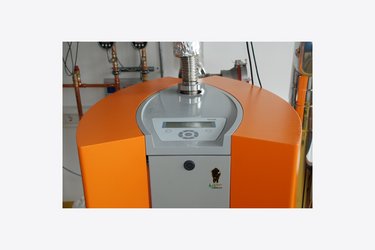
The laboratory is equipped with various operational heat generators. After the specific features of boilers and water heaters have been discussed as a supplement to the lecture, measurements are carried out with the aim of determining typical performance indicators that are important for the operation of the equipment.
First and foremost, the heat quantities transferred to the system are measured (and calculated). At the same time, investigations are carried out into flue gas losses. Efficiency and utilisation factors are calculated, as are condensate volumes in condensing boilers.
The pH value of the condensate must be determined. Finally, investigations are carried out into flue gas quality and combustion residues.
Programming exercises
Alongside the investigations into boilers and water heaters, practical exercises are carried out to familiarise participants with key control functions, using both permanently installed and portable control units.
Selected basic programmes for the control units must be chosen and, where necessary, adapted to the specific system configuration. Students should familiarise themselves with the structure and layout of the programmes (menus). Heating controllers must be adjusted or parameterised in accordance with specifications. Any operational messages and fault messages that occur must be identified and acknowledged. At the end of the practical session, data is backed up using a PC.