
Fuel Technology 1 – Gaseous Fuels
Determination of the calorific value and heating value of natural gas H
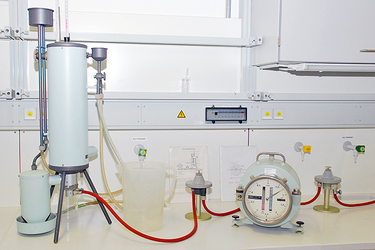
- using the precision laboratory calorimeter, applying the principles of thermodynamics and combustion engineering (DIN 51857)
- Calculation of the gross calorific value and net calorific value under standard conditions
- Comparison of the determined values with the specified values provided by ONTRAS GmbH.
Fuel Technology 2 – Liquid Fuels
Determination of the properties of heating oil EL: density, viscosity and flash point
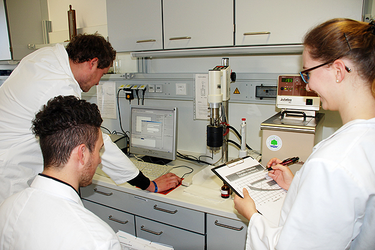
- Comparison of the measured values with the requirements for HEL as specified in DIN 51603-1.
- Determination of density using the DMA 48 by the flexural vibration method at different temperatures and comparison with other density determination methods (areometer, hydrostatic weighing, DIN 51757, DIN ISO 12185).
- Determination of dynamic viscosity using the VT 550 rotational viscometer at different temperatures. Calculation of kinematic viscosity.
- Determination of the flash point in a closed crucible according to the Pensky–Martens method (DIN EN ISO 2719)
Fuel Technology 3 – Solid and Liquid Fuels
Determination of carbon and sulphur content using the EA 2000 analyser
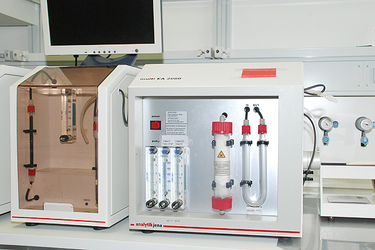
- Simultaneous determination of carbon and sulphur in solid biomass fuels and EL heating oil.
- Calculation of calorific values using the approximation equations.
- Comparison of the results from the calorimetric determination (C4000) and the elemental analysis (EA 2000) with each other and with DIN 51603-1.
Fuel Technology 4 – Solid and Liquid Fuels
Determination of the calorific values and heating values of solid biomass fuels and EL heating oil
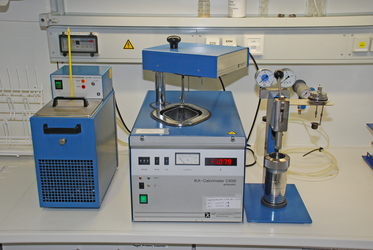
- Introduction to the adiabatic system
- Determination using the C 4000 bomb calorimeter in accordance with DIN 51900-1
- Determining the heat capacity of the calorimeter system
- Calculation of the calorific and heating values of the fuels
Contact
Responsible academic staff member

Prof. Dr.-Ing.
Uwe JungChair of Power Plant Engineering/Energy Economics

