
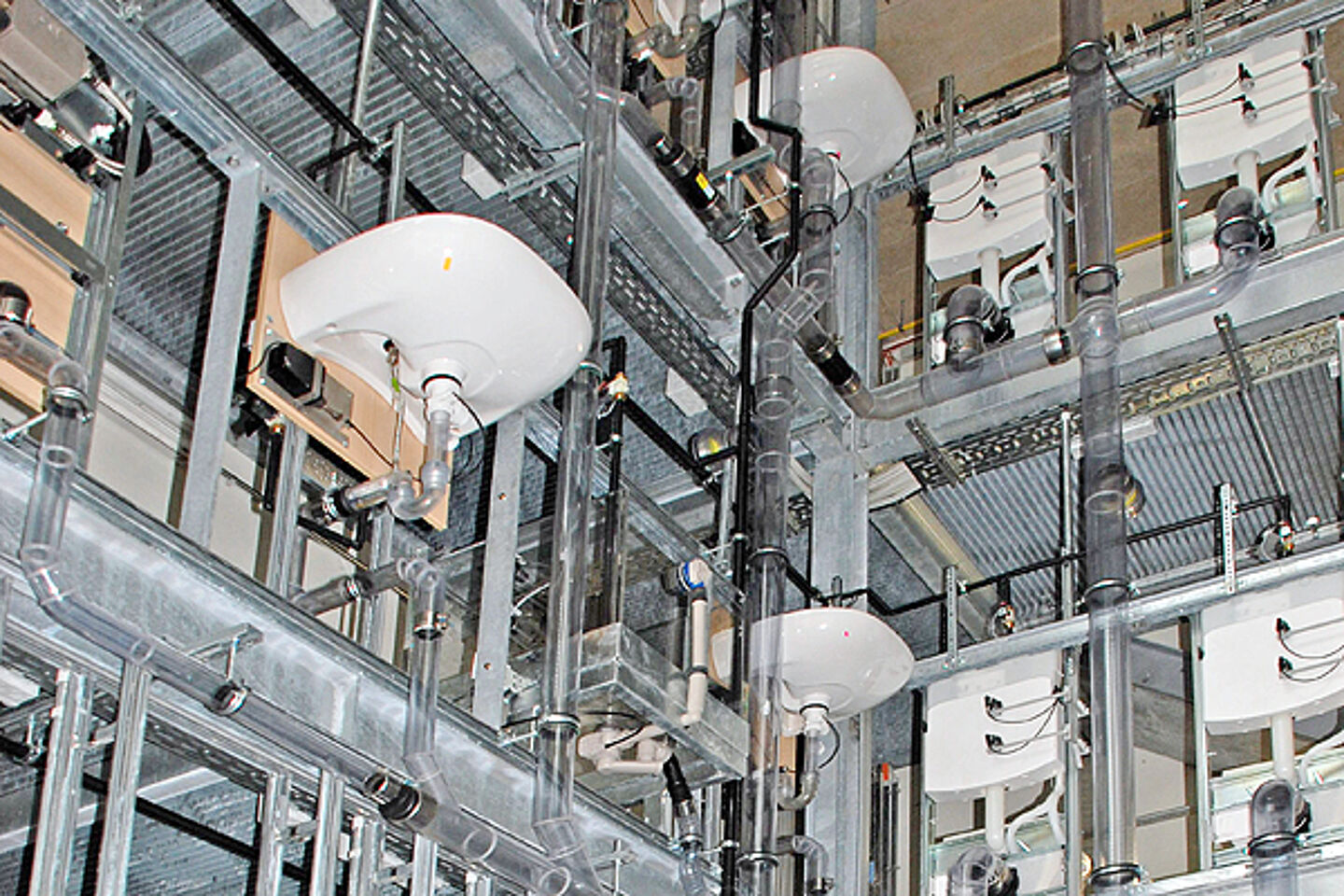
Sewage treatment plant
The wastewater tower is a replica of real-life drainage systems. Using transparent pipework, it demonstrates flow conditions in both correctly and incorrectly installed systems. In conjunction with standard fittings (washbasin, toilet, urinal) and replicas (bath, roof surface), students can observe the flow patterns and potential problems with the transport of solids through the pipework. Students are tasked with identifying faulty installations and explaining their consequences. Backflow, suction-drying and deposits are visible through the transparent pipework. The noise generated when trap seals are sucked dry is clearly audible. In contrast, no comparable phenomena are observable in installations that comply with regulations, as students can verify for themselves in parallel experiments.
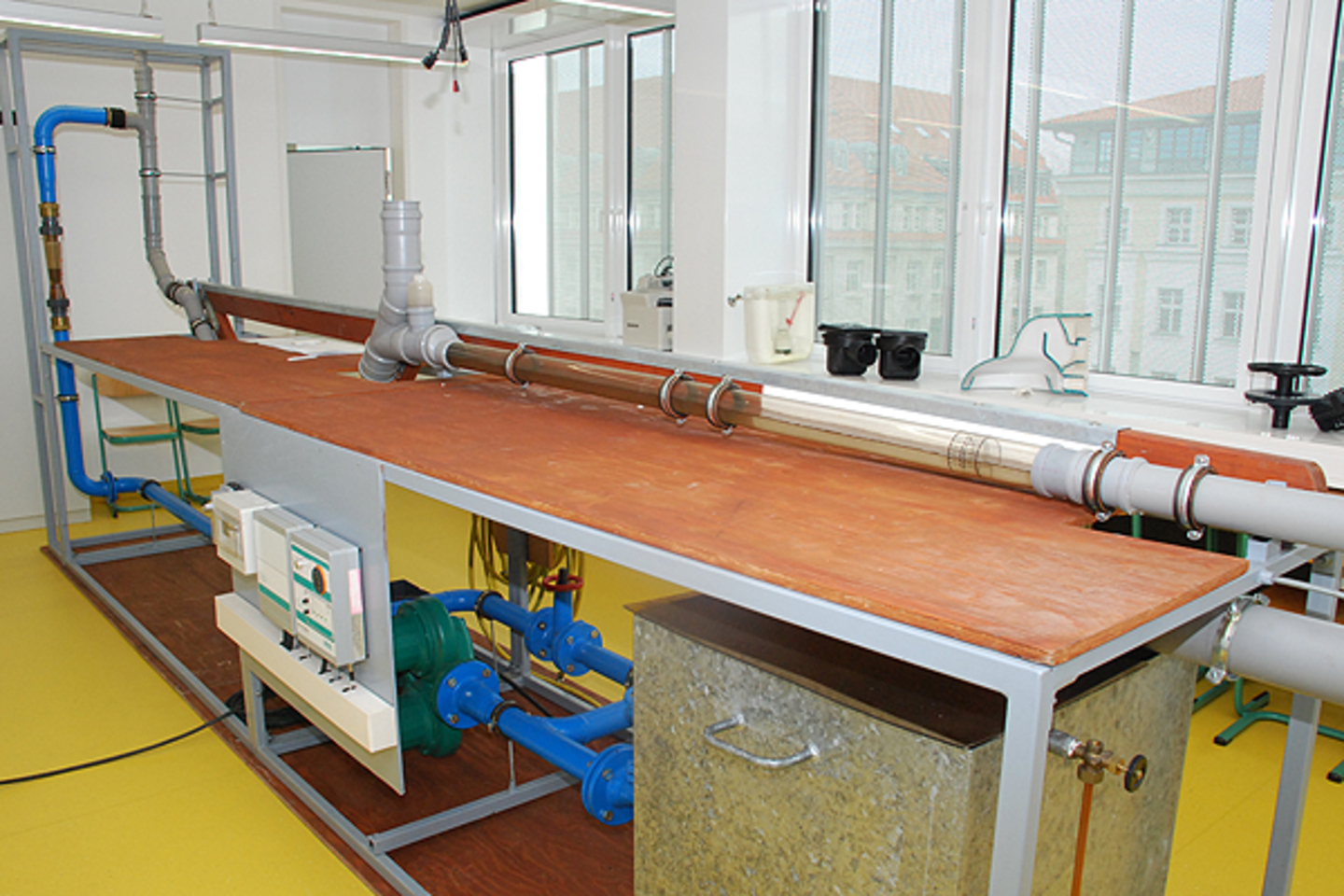
Open-channel flow
A key characteristic of flow in drainage pipes is what is known as free-surface flow. In this case, there is still air in the pipe above the flowing water. One advantage of this type of flow is the possibility of a constant, unhindered gas exchange with the atmosphere (the surrounding environment). More importantly, however, as the water level rises, the volumetric flow rate to be transported can continue to increase, in some cases exceeding the value for full-pipe conditions. On this test rig, students learn about the flow behaviour in partially filled, unpressurised drainage pipes. For different pipe bed gradients, flow rates must be set and recorded depending on the current water level. The measured values must be verified by calculation as part of the experimental analysis. The results yield velocity and volumetric flow rate profiles depending on the selected gradient (1:50 or 1:100).
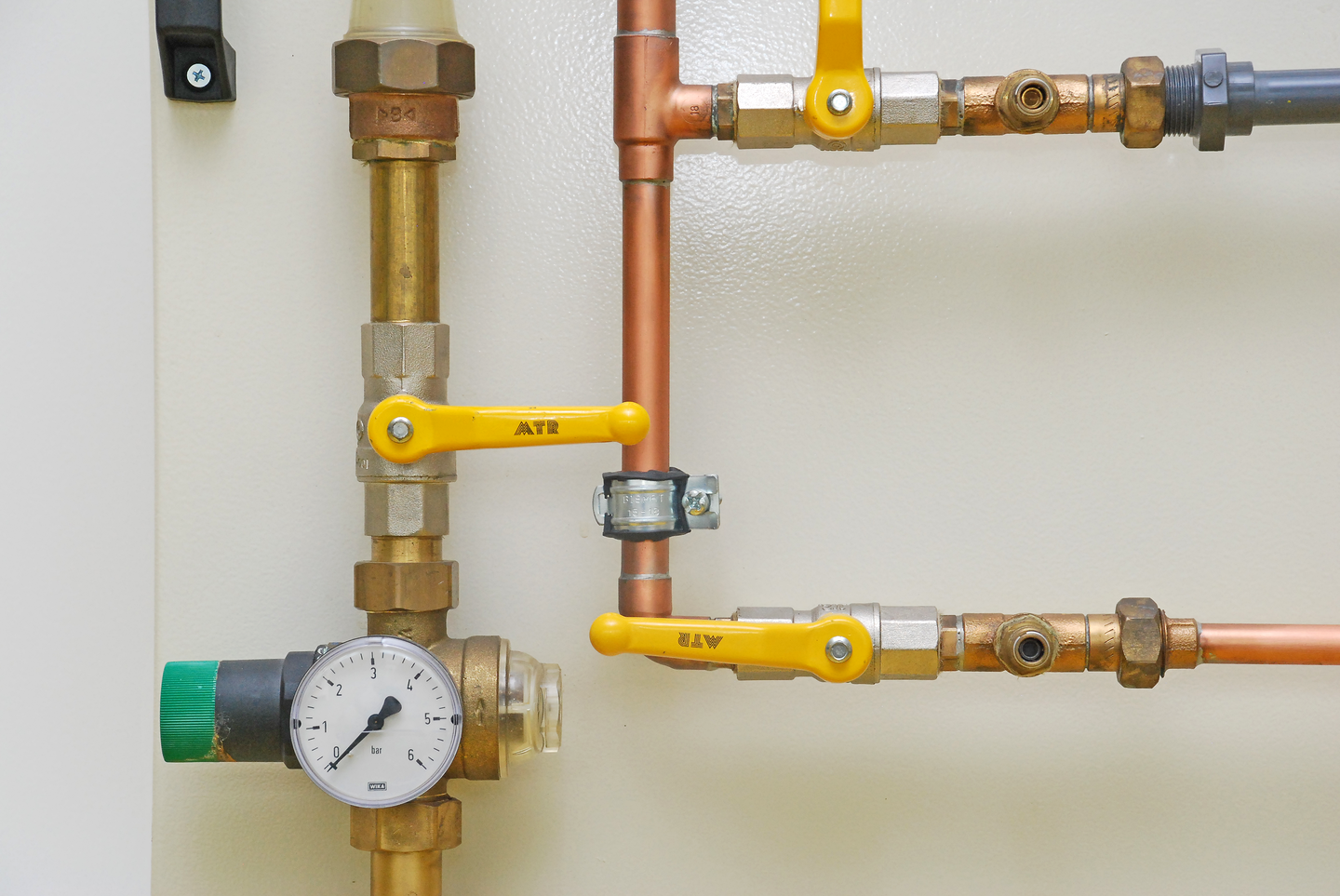
Longitudinal expansion of pipework
In both heating and plumbing systems, pipework is subject to fluctuating thermal influences which, at varying intervals, place stress on the pipework itself as well as on the pipe fixings. The resulting longitudinal expansion varies depending on the materials selected and the temperatures involved.
Longitudinal expansion is of particular importance for pipework routing. Students measure and calculate the longitudinal expansion of various pipe materials as a function of temperature. The linear coefficient of expansion must be determined from the measurements.
Pressure losses in straight pipes
Accurate pressure loss calculations are essential for the proper functioning of plumbing and heating systems. The experiments are based on fundamental knowledge of fluid mechanics, which the students have already learnt.
Cold water is passed through pipes of different materials and diameters, and the differential pressures are measured. Based on this, the students plot the pipe network characteristic curve. At the same time, the pressure losses are calculated. Measured and calculated values are compared. Any discrepancies that arise are discussed.

Pressure losses in structural elements
Knowledge of the magnitude of so-called individual resistances is of particular importance for the proper functioning of plumbing and heating systems. In specific situations (heat exchangers, building service connections and distribution stations), individual resistances may exhibit greater flow losses than straight pipe sections. Failure to take this into account can have a noticeable impact on system performance. The experiments are based on fundamental knowledge of fluid mechanics, which the students have already learnt. Individual resistors (clean and dirty water filters; water meters) are used as model components due to their relatively high losses. Cold water is passed through these components, which are used as representatives of other fittings (elbows, bends, T-pieces, manifolds, etc.), and differential pressures are measured. Based on this, students plot the pressure loss characteristic curve for these components. Based on the theoretical relationships, the pressure losses are calculated in parallel with the measurements. Measured and calculated values are to be compared. Any discrepancies that arise are to be discussed.
