
At the 15th East German Energy Forum, held at the Jahnallee campus of the University of Leipzig, HTWK Leipzig will be showcasing selected projects that are driving the energy transition
Under the theme ‘Security in Uncertain Times’, the East German Energy Forum will address the issue of security of supply on 30 September and 1 October 2026: Around 500 experts from academia, industry and politics will gather at the Jahnallee Campus of the University of Leipzig to discuss, amongst other things, affordable energy, overburdened systems, the boom in large-scale battery storage, new raw materials projects, the financing of the heating transition and the rising electricity demand from AI data centres. The event is organised by the Association of Business Organisations in Eastern Germany and Berlin. HTWK Leipzig will also be taking part. Researchers from the university will contribute to the specialist programme and the accompanying exhibition.
HTWK involvement: debate, workshop and exhibition
On Wednesday afternoon, Jens Schneider, Professor of Networked Energy Systems at HTWK Leipzig, and Antonio Hurtado, Professor of Hydrogen and Nuclear Energy Technology at TU Dresden, will hold a debate to provide a scientific context for the main theme (30 September, 2.00 pm – 2.30 pm, main lecture theatre). Shortly afterwards, a workshop on the planning and implementation process for geothermal plants will begin. This is being organised as part of the EASyQuart-Plus collaborative project led by HTWK, with the University of Leipzig, geoENERGIE Konzept GmbH and BauGrund Süd mbH taking the lead (30 September, 3.00 pm – 3.30 pm, workshop room). This workshop will provide insights into both the practical application of near-surface geothermal energy and its role in municipal heating planning.
Those interested can find out more about theEASyQuart-Plus project in the exhibition area: at the stand, Anke Bucher, Professor of Applied Mechanics, and Max Jäschke, research assistant, from HTWK Leipzig, together with the project partners, will explain how geothermal systems can be planned more efficiently and cost-effectively. They will also be presenting a 3D visualisation, including simulation and measurement data from a geothermal probe system, and aim to dispel preconceptions and misconceptions about near-surface geothermal energy through discussions. Another new feature is a virtual reality tour, using VR headsets, through a building heated by geothermal energy.
Four more research teams in the exhibition area
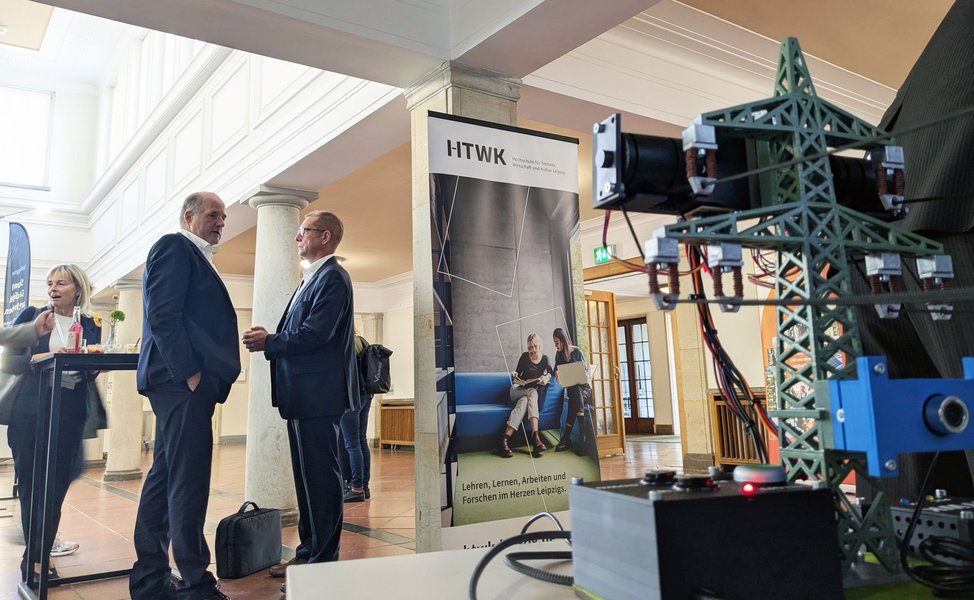
The team led by Faouzi Derbel, Professor of Smart Diagnostics and Online Monitoring and Vice-Rector for Research and Sustainability at HTWK Leipzig, is presenting a measurement system developed as part of the Zapdos research project. The patented diagnostic system uses the sag in an overhead power line’s conductor cable to measure how much energy is flowing through the power lines and what the actual capacity can be to meet growing energy demand. This allows the grid to be utilised more efficiently without the need for expansion. “At present, our research is also focusing on the protection of critical infrastructure, as power lines are, unfortunately, also subject to acts of vandalism and sabotage that can disrupt the energy supply,” explains research assistant Johannes Braun.
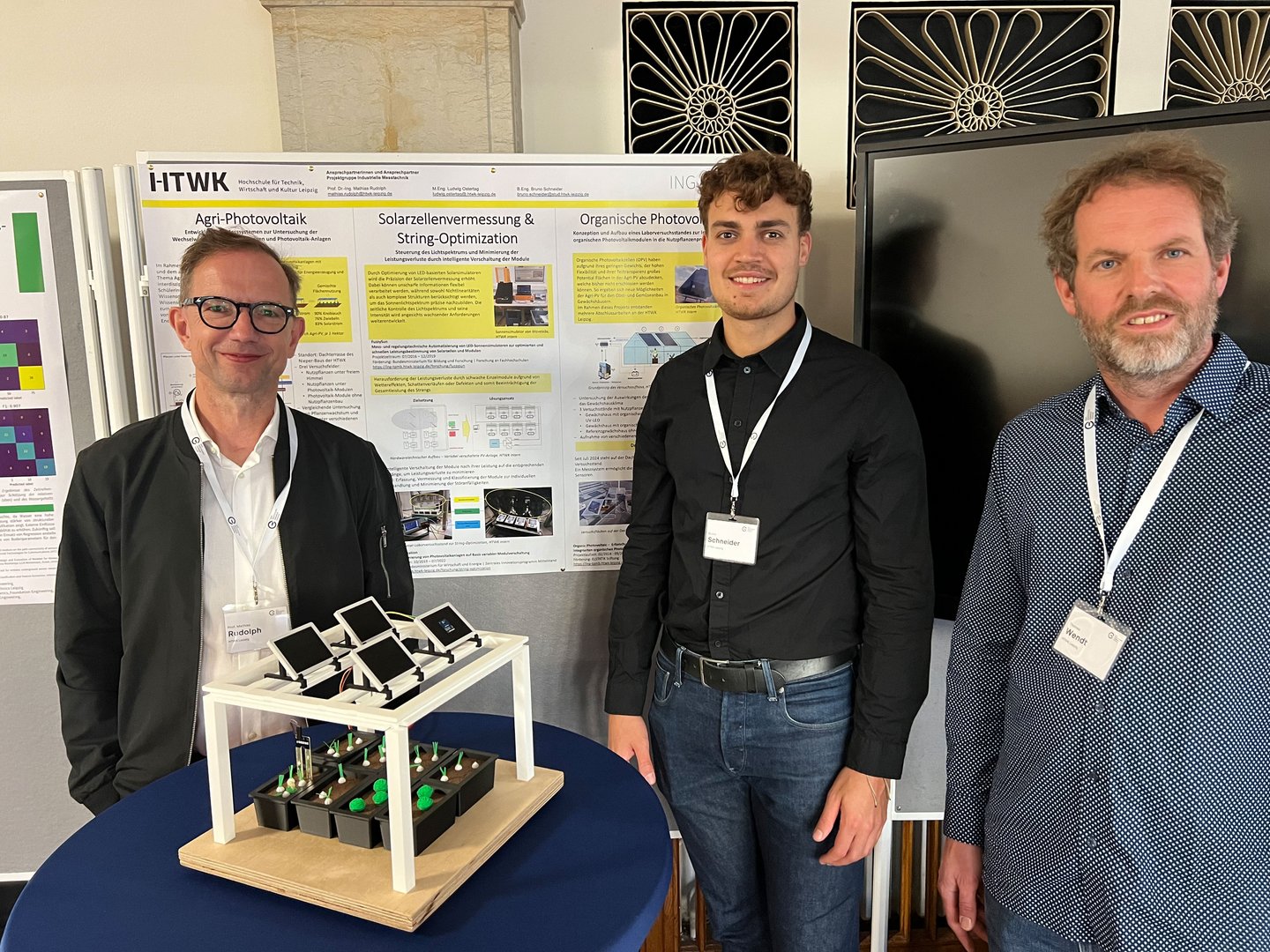
The team led by Mathias Rudolph, Professor of Industrial Metrology, provides insights into three further research projects: in addition to application-oriented solar cell measurement, these include agri-photovoltaics (Agri-PV) and organic photovoltaics (OPV). Agri-PV combines energy generation with agriculture. OPV films are extremely light, flexible and unbreakable, offering a wide range of applications for generating environmentally friendly electrical energy.
New to the project are researchers from the EMC Centre at HTWK Leipzig: with increasing digitalisation and networking, electromagnetic compatibility (EMC) is becoming ever more important in preventing interference with communication and power supply networks or with devices and systems. To demonstrate radio interference, they will be bringing, amongst other things, a spectrum analyser and an antenna.
The HTWK start-up team from Sektor Eins is presenting new software for energy management and sector coupling. For staff working in energy and building services engineering, they have developed a simpler approach to monitoring, enabling a quicker and easier response to dynamic situations relating to electricity and heat consumption. Those interested can view the demo software on site and seek advice.
Media technology students produced video clips
In addition, the Events Office of the Faculty of Computer Science and Mediais once again providing organisational and creative support: media technology students have produced video clips to be shown on stage, which will enhance the multimedia presentations in the main forum.
