The Finnish 3D printer rounds off the DFG’s major equipment funding programme and enables new ideas in multi-material printing to be put into practice
“The new 3D printer opens up entirely new possibilities in functional 3D printing, as it combines four materials and four processes simultaneously in every layer,” says Ingo Reinhold, Professor of Coating Processes at HTWK Leipzig. Very few printers can do this.
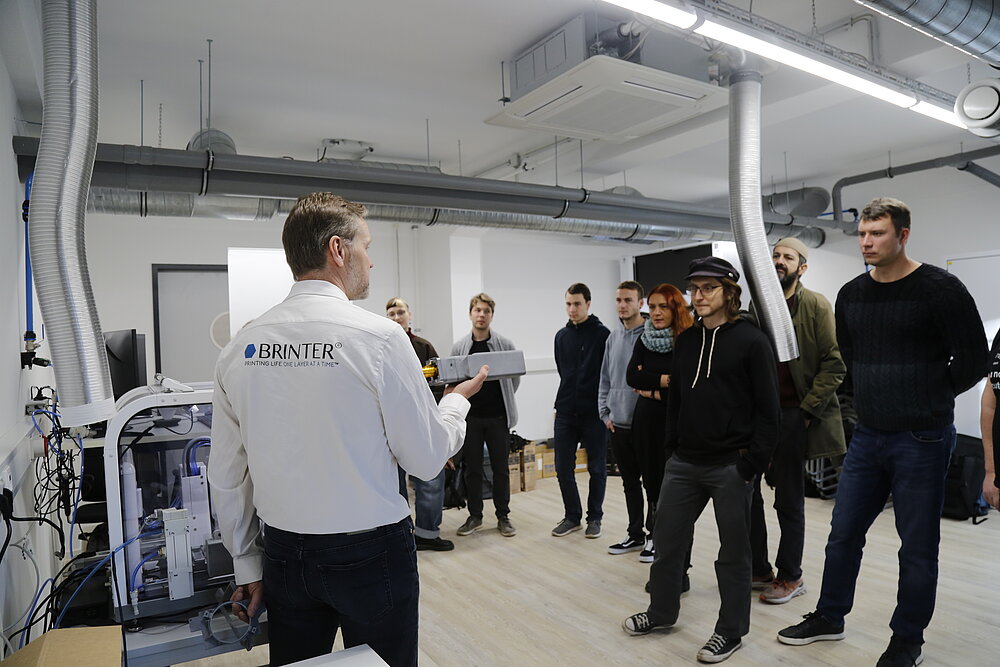
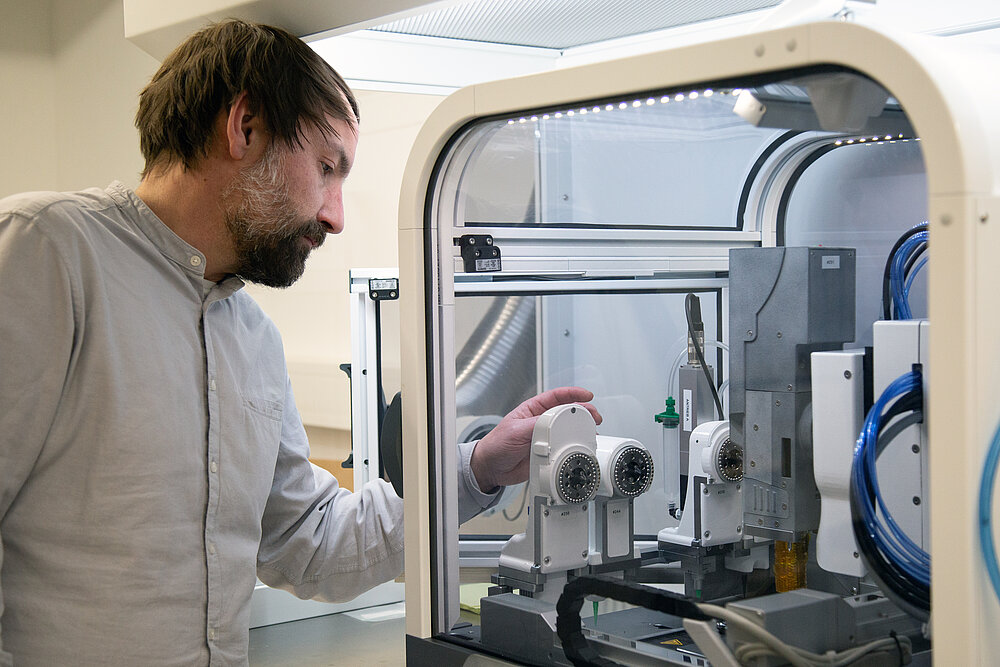
The research platform from the Finnish company Brinter AM Technologies OY has been based at HTWK since December 2025: With a build volume of 30 centimetres wide, 17 centimetres deep and 8 centimetres high, it is not intended for large-scale production, but rather for research aimed at gaining new insights: The bio-printer can not only combine four different materials and various printing processes simultaneously, but also actively cool, heat, mix and cross-link them using UV light, all independently of one another. The printer has now undergone initial testing and is ready for use in the new Additive Multimaterial Manufacturing – Lab (AM³-Lab) on the Liebknechtstraße campus.
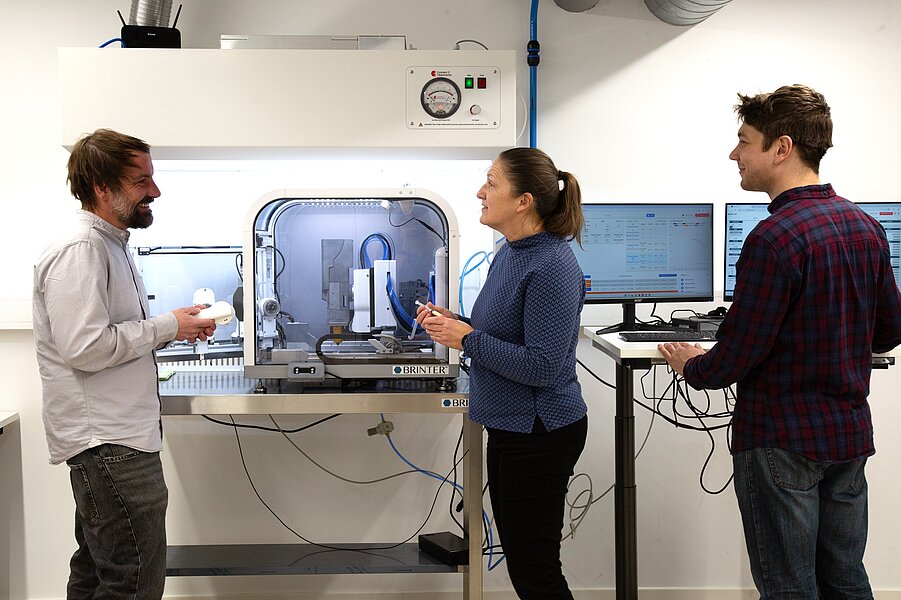
Precise control of component properties through a wide range of interchangeable print heads
A wide range of interchangeable print heads enables the localised placement of up to four different materials within a single component – and even within a single layer. Different printing processes, such as inkjet (ink), thermoplastic extrusion (granules), compressed air extrusion or screw extrusion (paste-like materials), can be combined. By combining different materials per print head and precisely adjusting parameters such as air pressure, nozzle size, feed rate, temperature and curing, it is possible to precisely control mechanical properties, surface quality, detail resolution and functional zones within the component.
“By providing access to the machine code (G-code) and allowing the free use of materials, the printer offers us a wide range of possibilities. For us, the printer thus becomes a playground. We have lots of ideas that we can now finally try out and see which ones are feasible and how,” says Lukas Kube, laboratory engineer at HTWK Leipzig.
Areas of application: From biotechnology through mechanical engineering and packaging technology to civil engineering

The bio-printer was originally developed for biotechnology and biomedicine. At HTWK Leipzig, however, it will primarily be used for fundamental research in mechanical engineering, electrical and sensor technology, printing and packaging technology, and civil engineering.
For example, sound-absorbing structures, sensor electronics or batteries could be manufactured. Applications such as those in the PaperRock research project are also conceivable, in which medical test strips are produced onto which materials could likewise be printed or embedded. “With this equipment, we are learning to gain a fundamental understanding of multi-material processes and to use these combinations to efficiently create novel functions,” summarises Kube.
Bio-printer completes DFG major equipment grant
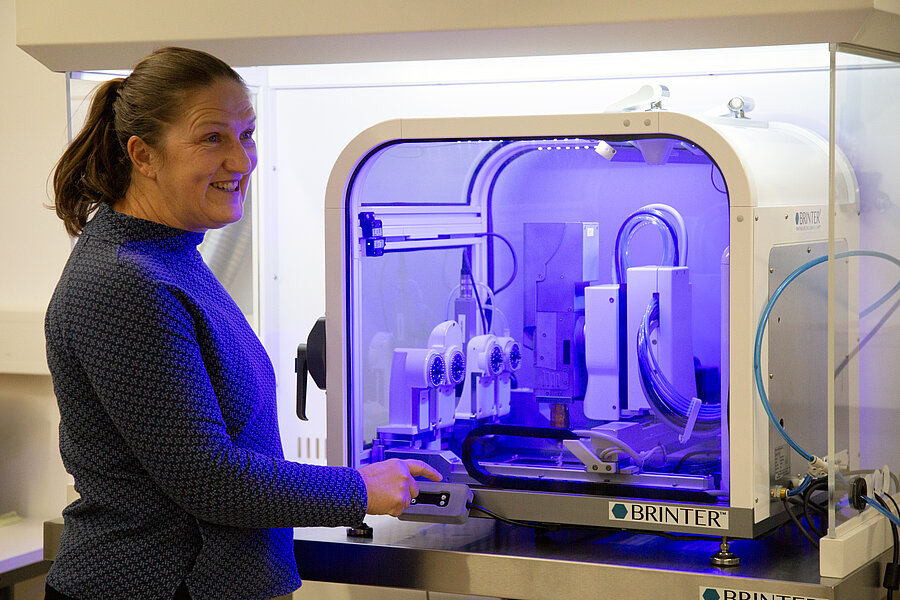
The 3D bioprinter, called the Brinter One 2.0, from the Finnish company Brinter AM Technologies Oy is the centrepiece of a specialised and comprehensive development environment that has cost several hundred thousand euros. It rounds off the large-scale equipment funding provided by the German Research Foundation (DFG) in the field of ‘multimaterial additive manufacturing’ (AM) at HTWK Leipzig.
The professors involved in the DFG application and the Multimaterial AM research area are: Prof. Dr.-Ing. Ingo Reinhold (Chair of Coating Processes), Prof. Dr.-Ing. Lutz Engisch (Chair of Materials), Prof. Dr.-Ing. Paul Rosemann (Chair of Materials Engineering), Prof. Dr.-Ing. Faouzi Derbel (Chair of Smart Diagnostics and Online Monitoring) and Prof. Dr. rer. nat. Ines Dani (Chair of Additive Manufacturing Technology).
Other large-scale machines in the field of multi-material additive manufacturing
A powder shear cell from Anton Paar, complete with a climate chamber, has been in use on a precision rheometer since spring 2025. This enables researchers to determine the flow properties of powders in a controlled temperature and humidity environment, thereby optimising powder deposition in 3D printing and developing functional composite materials and components. In autumn 2025, the researchers commissioned the state-of-the-art ‘Voxeljet VX200 HSS’ polymer 3D printer, which enables them to develop new materials and processes, as well as to produce prototypes or small-batch components quickly and flexibly for research purposes.
Researchers from the university and its associated Research and Transfer Centre (FTZ Leipzig) across all disciplines can use the equipment.