
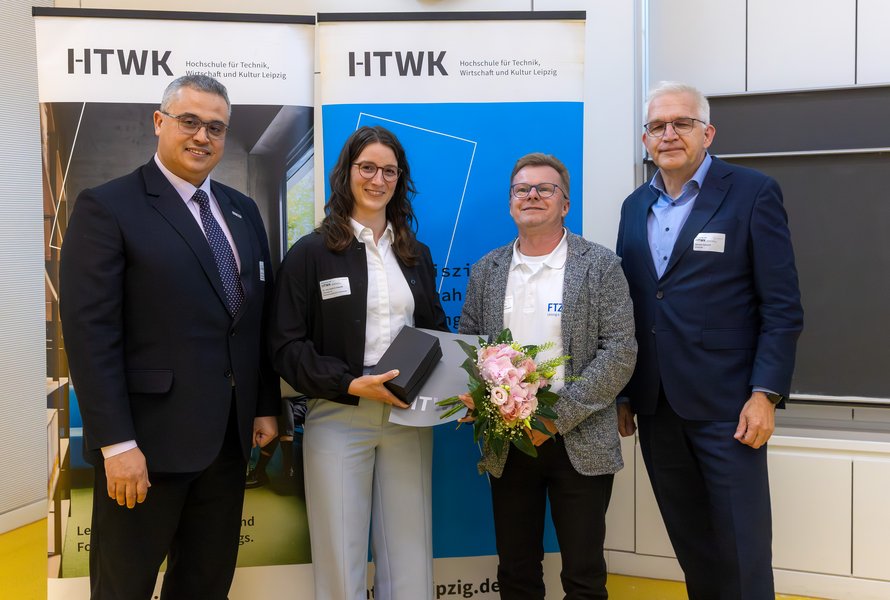
The HTWK Foundation awarded Dr Ann-Kathrin Dieterle the 2026 Dissertation Prize for her research into organisational resilience in companies
Conflicts, crises and dynamic developments – such as those caused by wars, pandemics or technological upheavals linked to digitalisation and AI – present companies with major challenges: To cope with these unexpected changes, they must anticipate the altered conditions as quickly as possible, prepare for them and adapt their strategies for the long term. This ability is referred to as organisational resilience. Cross-organisational collaboration can also help in this regard, as Dr. rer. pol. Ann-Kathrin Dieterle highlighted in her doctoral thesis. The HTWK Foundation recognised her research with the 2026 Doctoral Thesis Prize.
In her doctoral thesis entitled ‘The Role of Inter-organisational Cooperation for Resilience: An Analysis of Organisational Processes, Strategies, Practices, and Sources’, which she wrote at HTWK Leipzig in collaboration with the Brandenburg University of Technology Cottbus-Senftenberg. For her research, she brought together existing findings from organisational, supply chain and regional economic research for the first time. She also examined examples of corporate cooperation in the context of both short-term and long-term crisis triggers and carried out case studies in established companies.
How should productive partnerships be structured?
Research has so far focused on how individual companies can become more resilient. Less attention has been paid to the role that collaboration can play. Yet such partnerships between companies, start-ups and research institutions already exist – for example, to develop innovations, exchange knowledge or respond jointly to supply chain risks during crises. Dieterle therefore set out to investigate exactly how cross-organisational collaboration contributes to corporate resilience and how it can be structured in practice.
“My analysis shows that short-term, flexible collaborations help to overcome acute crises, whilst long-term partnerships lay the foundations for sustainable adaptation,” says Dieterle. Companies can actively build resilience, particularly when they combine different innovation strategies. It is precisely the use and combination of internal initiatives and external collaborations that enable genuine capacity for renewal, as this creates a greater diversity of skills and resources. The quality of the collaboration is crucial for strengthening resilience through partnerships. Among other things, agility, improvisation, mutual appreciation and a willingness to learn together play a central role in this.
Findings and recommendations for action
She set out the findings of her doctoral thesis in four academic publications, in which she examined the topic from a range of perspectives: from its theoretical framework, through the strengthening of strategic resilience via collaboration and innovation as a proactive resilience strategy, to collaboration with start-ups as a practical application. She also derived practical recommendations for action aimed at management within organisations.
“During the COVID-19 pandemic, for example, restaurants and supermarkets worked together and flexibly swapped staff at short notice, so that employees did not have to be made redundant,” explains Dieterle. In other collaborations between medical technology companies, rapid COVID-19 tests were jointly developed, whilst distilleries were provided with the know-how to produce disinfectants for medical use. In other sectors, meanwhile, staff were organised into shifts to maintain critical infrastructure. Most companies have plans in place to prepare for emergencies and unplanned scenarios, such as the coronavirus pandemic.
“As organisational resilience does not arise solely within a single company but can be strongly shaped by networks, I recommend that companies actively strengthen their resilience by purposefully building partnerships, sharing knowledge and designing joint innovation processes,” says Dieterle. Specifically, she advises senior management to create internal roles dedicated to actively seeking out suitable partners, such as innovation scouts who identify start-ups, or innovation translators who act as intermediaries between collaboration partners and internal business units.
Relevance to business practice
“By focusing on crisis triggers across different time horizons – from the Covid-19 pandemic, with its very short-term challenges, to the long-term transformation of entire energy systems following the phase-out of nuclear power and lignite– a very wide range of strategic recommendations that are equally relevant for established companies of various sizes,” says Rüdiger Wink, Professor of Economics at HTWK Leipzig, who co-supervised the thesis on behalf of the university.
The new academic findings and the concrete ideas for fostering organisational resilience through collaboration are particularly exciting for business practice. “It is of particular interest to all those sectors of the economy that are currently facing challenges and undergoing transformation processes. These currently include, for example, the energy sector, the automotive industry, the healthcare sector and the construction industry,” said Dieterle.
Brief CV
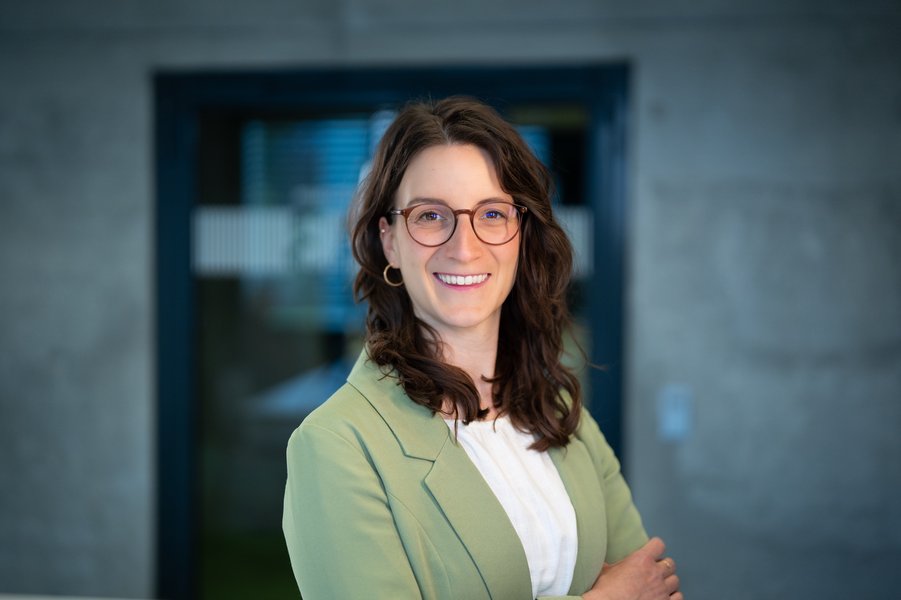
Dr Ann-Kathrin Dieterle studied Cultural and Media Education at Merseburg University of Applied Sciences, Communications in Creative Multimedia at the Dundalk Institute of Technology, and General Management at HTWK Leipzig. Her Master’s thesis already focused on the topics of change management and innovative business models. In her subsequent roles from 2018 to 2024, first in the interdisciplinary early-career research group ‘DigiTransSachs’ at HTWK Leipzig and then at HTWK’sstart-upconsultancy Startbahn 13, her research into the added value that collaboration offers in adapting to new developments also contributed: to the mission of “DigiTransSachs” to develop practical solutions for the digital transformation of Saxon companies, and to the work of Startbahn 13, where she experienced first-hand the role that start-ups can play as collaboration partners for established firms. Since March 2024, as a research associate in the ‘Innovation Policy and Transfer Design’ group at Fraunhofer ISI in Leipzig, she has been applying her insights into collaboration dynamics and innovation management directly to applied research on transfer structures and regional transformation processes.
