
How can small and medium-sized enterprises make effective use of artificial intelligence? On 25 August, HTWK professor Alexander Stahr presented specific applications from the world of research at the Leipzig Chamber of Industry and Commerce (IHK) and introduced the Applied AI network
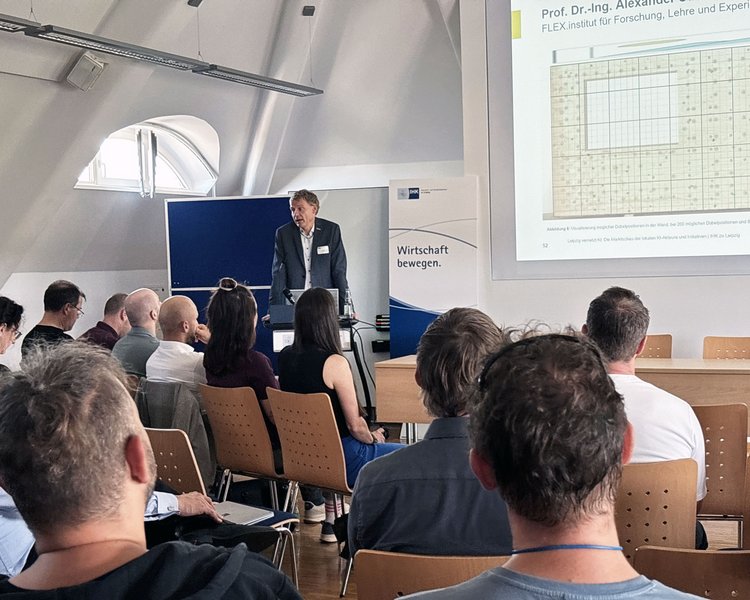
Companies are increasingly faced with the question of how AI can be usefully integrated into existing workflows. Small and medium-sized enterprises (SMEs) in particular face specific challenges in this regard: they often have valuable data from production, customer contacts or business processes, but do not always have the necessary structures and expertise to utilise this data for AI applications.
How to successfully bridge the gap between technology and practical application was the focus of the ‘Leipzig Connects AI’ event. Initiated by the Leipzig Chamber of Industry and Commerce (IHK), this networking event brought together regional businesses, research organisations, start-ups and IT service providers. The focus was on specific points of contact and practical examples of application, rather than abstract promises about the future.
HTWK Leipzig contributes its expertise in AI
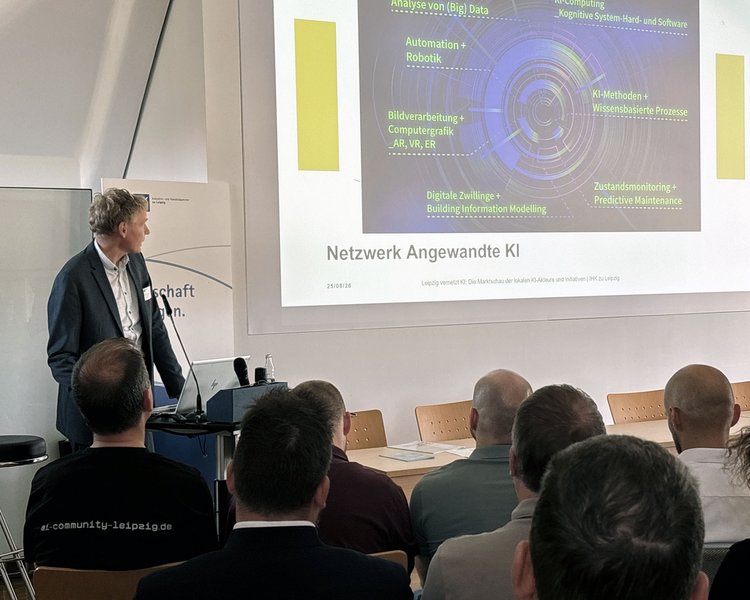
HTWK Leipzig was also represented, showcasing its expertise. Prof. Alexander Stahr from the FLEX.Research Institute provided insights into the university’s own ‘Applied AI’ network. Within this network, academic chairs from all faculties pool their teaching, research and knowledge transfer activities relating to artificial intelligence and data science.
Stahr demonstrated how AI is already being applied in specific fields of research and practice. In his team at the FLEX.Research Institute and at the HolzBauForschungsZentrum, artificial intelligence methods are being used, amongst other things, at the interface between architecture and structural engineering. The aim is to achieve end-to-end digital processes – from design through planning and prefabrication to assembly.
The breadth of AI research at HTWK Leipzig is also illustrated by the work of Prof. Mirco Fuchs, Professor of Computer Vision and Machine Learning. His research focuses, amongst other things, on the automated analysis of image and video data. For instance, Fuchs is investigating how video data from canoe racing can be analysed more effectively with the help of AI.
These examples illustrate that AI does not always have to begin with the development of a complex system from scratch. Often, the greatest benefit lies in the targeted integration of existing technologies into current processes – for example, by automating repetitive tasks, analysing data or supporting decision-making processes.
Regionally connected
Networking events such as ‘Leipzig vernetzt KI’ forge an important link between technological expertise and business practice. The regional AI landscape offers companies the opportunity to find suitable partners for specific challenges – ranging from research collaborations to ready-to-use applications.
SMEs can contact the Applied AI Network at HTWK Leipzig with any questions or ideas regarding research collaborations: https://www.htwk-leipzig.de/forschen/institute-kompetenzzentren/netzwerk-angewandte-ki
