

Key areas of research and development
- Power system events, switching transients
- Discharges at DC, mixed-frequency and high-frequency voltages
- Dielectric properties of insulating materials
- Electrical insulation systems
- High-voltage technologies
Stress on insulating materials and insulating sections caused by composite voltage (superposition of 50 Hz voltage and direct current)
Today, the generation and transmission of electrical energy is predominantly carried out using low-frequency alternating current, though increasingly using direct current. As long as conventional generators produce alternating voltage and both voltage forms play a role in energy transmission, they must be converted into the other form and insulated from one another at the ‘contact points’. In the process, the insulating section is subjected to a composite electric field. This means that the electric current field and the dielectric displacement field act simultaneously. Research topics include:
- Circuits for generating mixed voltages
- Physical effects of mixed-field stress in insulating materials and at interfaces with varying voltage components
- Measurement principles for mixed voltages and the resulting electric fields
Stress on insulating materials and systems caused by high-voltage direct current (HVDC) and a superimposed medium-frequency voltage
Major advances and cost reductions in semiconductor technology are enabling the increased use of power electronics topologies for the conversion, transmission and time-precise transformation of electrical energy, e.g. into kinetic and thermal energy for industrial processes. The provision of higher power levels, usually for short durations, is increasingly linked to higher voltages. The energetic coupling of two circuits via the magnetic field of medium-frequency currents results in technical advantages and high efficiency. Power electronic couplers (e.g. converters) thus operate at medium frequency. The electrical insulation sections are subjected to high-frequency changes in field strength (even in low-voltage technology). The cascading of power electronic circuits results in the superposition of medium-frequency square-wave or sinusoidal voltages of up to several kilovolts and of DC or AC voltages of up to several tens or hundreds of kilovolts. This type of dielectric stress on insulating materials and interfaces is a new phenomenon. Such voltage waveforms are generated by appropriate topologies implemented by the Power Electronics Research Group or by industrial firms, or by newly developed test generators and circuits developed by the research group. When the Research Group was founded, this field of research was new; today, many groups are working in this area. The importance of this field of research is growing.
Research topics include:
- Generation of a ‘representative’ test voltage in the form of high-frequency sinusoidal and square-wave high-voltage, circuits for superimposing a wide variety of voltage waveforms
- Polarisation and dielectric losses under medium-frequency sinusoidal and square-wave high-voltage, determination of the parameters for calculating losses and field distribution
- Discharges under sinusoidal and square-wave high-voltage conditions at interfaces (e.g. Toepler configuration) and gas gaps (e.g. tip-plate configuration)
- Design and insulation principles of medium-frequency transformers
High-voltage technologies
High voltages and electric field strengths have physical effects that need to be understood and can be utilised for technological processes or specific applications.
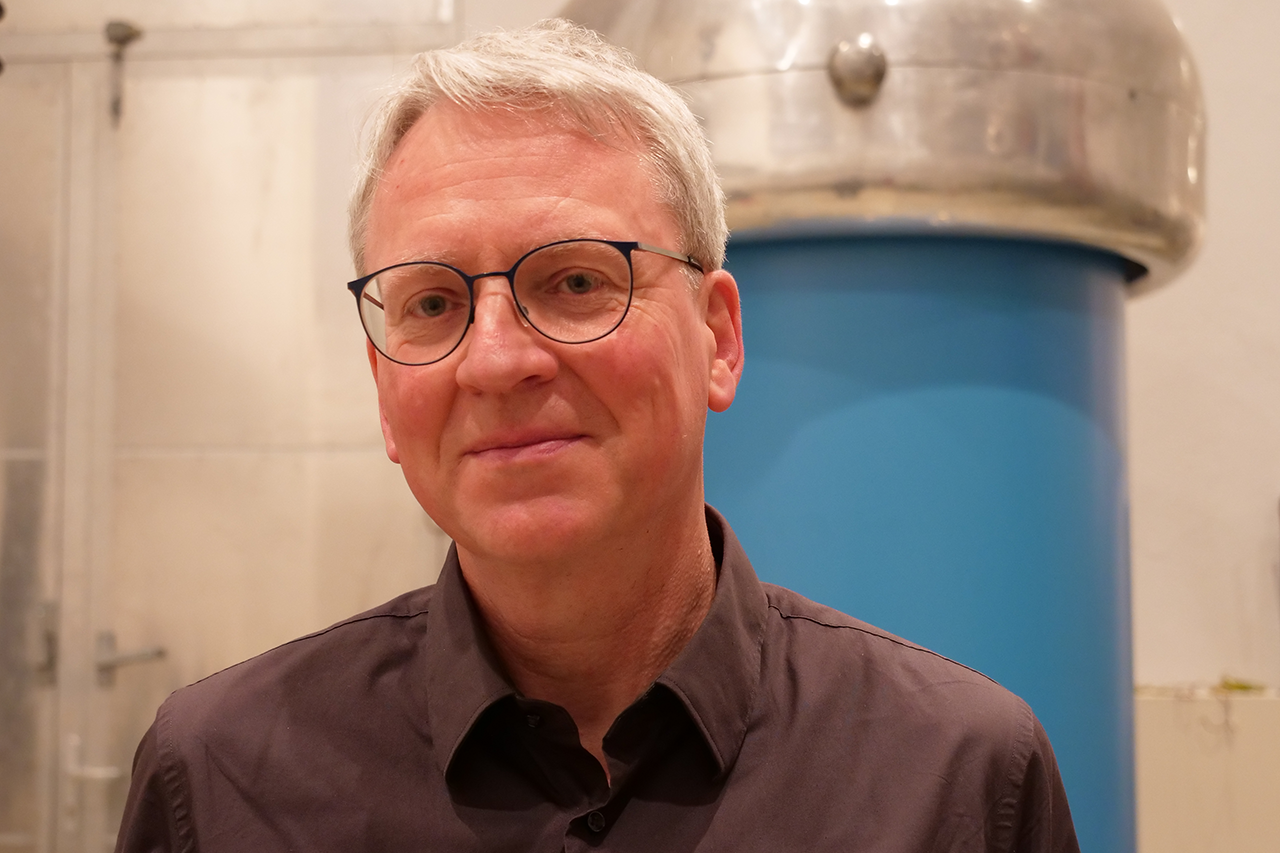
Prof. Dr.-Ing. Carsten Leu
Chair of Electrical Power Supply and High-Voltage Engineering
Institute
EET | Institute of Electrical Power Engineering
Telephone: +49 (0)341 3076 1273
Email: carsten(dot)leu(at)htwk-leipzig.de
HVDC MEASURE
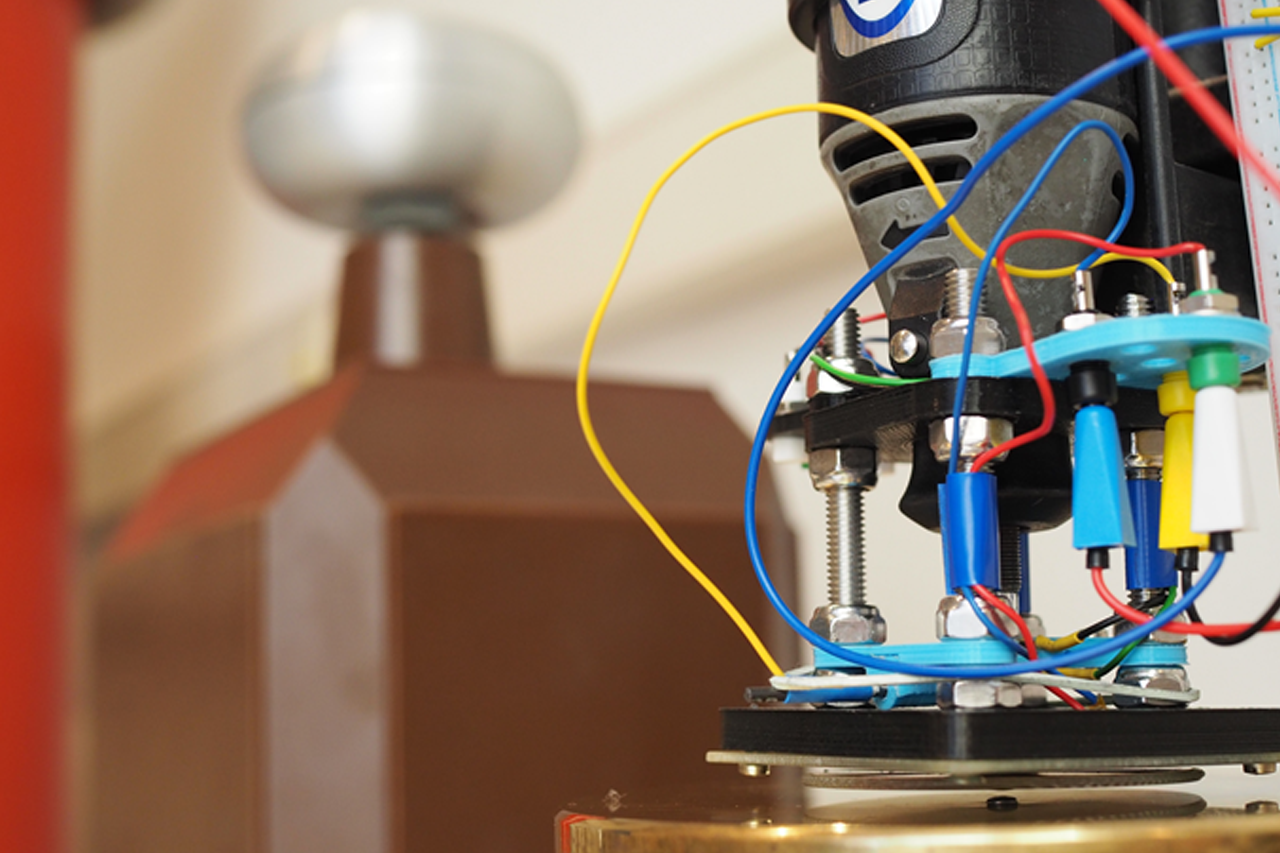
Development of a sensor head, including research into fundamentally suitable electrode configurations for different voltage waveforms and ranges
The aim is to reliably measure direct, alternating and mixed voltages using the principle of the generatoric voltmeter. Examples of instruments for measuring potential and voltage include rotary voltmetres, in which a grounded vane opens and closes an electrode segment, so that a capacitive current is generated by the change in the area of the capacitor arrangement, from which the voltage to be measured can be deduced. The potential of metallic parts or charged surfaces is measured exclusively via the induced voltage at the measuring head, using a high-impedance measurement. The electrical power supply systems of the future will operate with alternating voltage and direct voltage, but also with superimposed voltage waveforms. Charges occur particularly in DC systems. These must be detected reliably and without losses. Voltage dividers used to date require a measurement current and a metallic contact. This is avoided with the measurement principle to be further developed.
Funding: BMWi, ‘Central Innovation Programme for SMEs’ (ZIM)
Programme Project duration: 08/2021 – 01/2024
MF Discharge
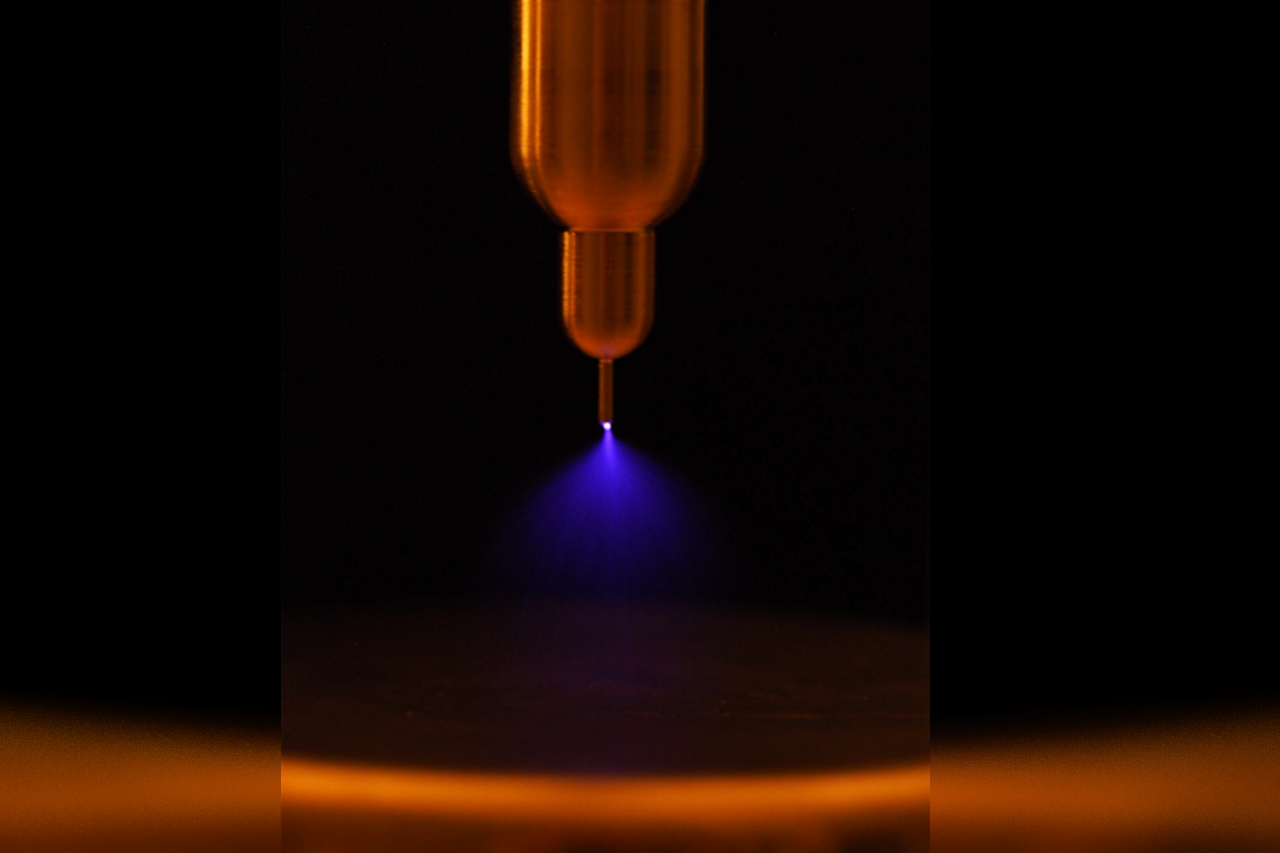
Discharges under DC voltage with superimposed medium-frequency AC voltage at interfaces in high-voltage insulation systems
The aim is to gain fundamental insights into physical effects and parameters for the design, implementation and operation of insulation systems that are subjected to a medium-frequency high voltage superimposed on a system voltage (direct current) (composite voltage). This project focuses on scientific investigations into ignition, discharge characteristics and the interference potential of partial discharges in general, and surface discharges in particular, as they occur in areas of high electric field strength and low dielectric strength, e.g. at the internal and external interfaces of solid insulating materials. These are found in high-voltage insulation systems of equipment used in new decentralised grids and electrical power supply systems.
Funding: DFG
Project duration: 06/2021 – 08/2023
