
Yesterday, the first networking workshop on smart models and digital twins took place at HTWK Leipzig
Mathematical models and digital twins are encountered quite frequently in both research and practice: they can be used, for example, to describe, simulate and predict physical, technical and economic processes, and to apply the results to real-world objects, thereby optimising processes, amongst other things. This field of research is gaining in importance against the backdrop of artificial intelligence, particularly in the context of Industry 4.0, automation and sustainable production. But how can mathematical models be made more efficient, interconnected and adaptable? At the first networking workshop on 29 and 30 September 2026 at HTWK Leipzig, nearly 40 researchers from various local scientific institutions came together to discuss current approaches to modelling, simulation and model reduction.
“The aim of our workshop was to facilitate an interdisciplinary exchange on how smart models and digital twins can be jointly developed and utilised in the future. By bringing these research institutions together, we can also pool and complement Leipzig’s expertise and establish future research collaborations,” says Jochen Merker, Professor of Analysis and Optimisation at HTWK Leipzig.
Making progress together
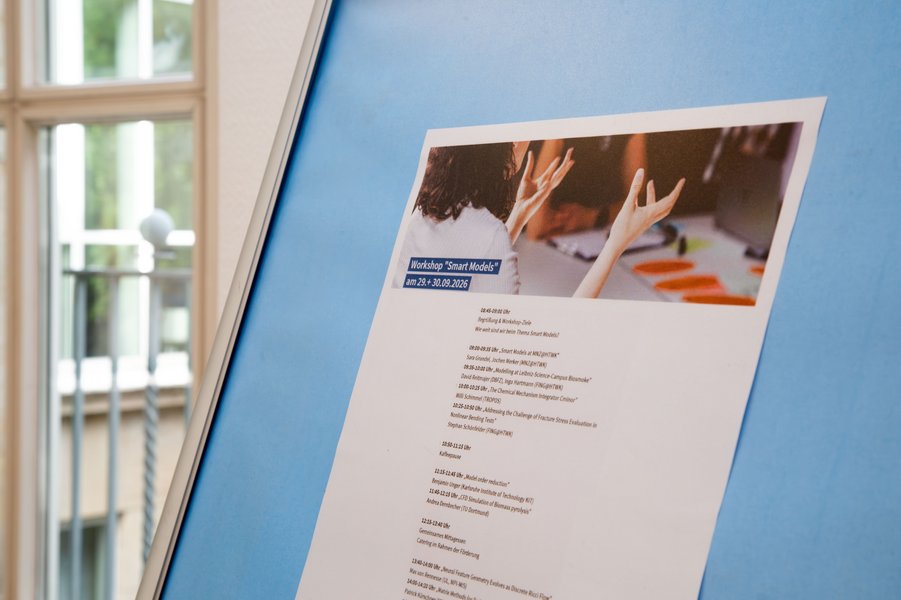
Together with members of the Helmholtz Centre for Environmental Research (UFZ Leipzig) and the Leibniz Institute for Tropospheric Research (TROPOS), his team organised the workshop. The event was funded by the ‘LSN NetzWerkstatt’, through which the Leipzig Science Network aims to foster new research collaborations in Leipzig and explore new fields of research.
Mathematical models play a major role at all three institutions across various disciplines – in mathematics, environmental and atmospheric research, numerical analysis, machine learning and research software. The planned workshop therefore offered deeper insights into specific problems arising from research into mathematical models. Speakers from HTWK Leipzig included, alongside Prof. Jochen Merker, Prof. Sara Grundel, Prof. Ingo Hartmann, Prof. Stephan Schönfelder, Prof. Patrick Kürschner, Florian Muschka and Akos Eröss.

Greater visibility for mathematics
Further external researchers complemented Leipzig’s expertise with keynote presentations and suggested topics for joint research. Speakers included Benjamin Unger from the Karlsruhe Institute of Technology (KIT), who spoke on ‘Model order reduction’, and Andrea Dernbecher from Dortmund Technical University, who spoke on ‘CFD simulation of biomass pyrolysis’.
The presentations and discussions were rounded off with open-format sessions, during which mathematical consultancy was offered and opportunities to participate in teaching and the supervision of final-year projects were explored. “The LSN ‘Smart Models’ workshop has provided an opportunity to raise the profile of mathematics at HTWK Leipzig and its significance for practical applications, which will certainly have a positive impact on future research collaborations,” summarises Prof. Jochen Merker.
