
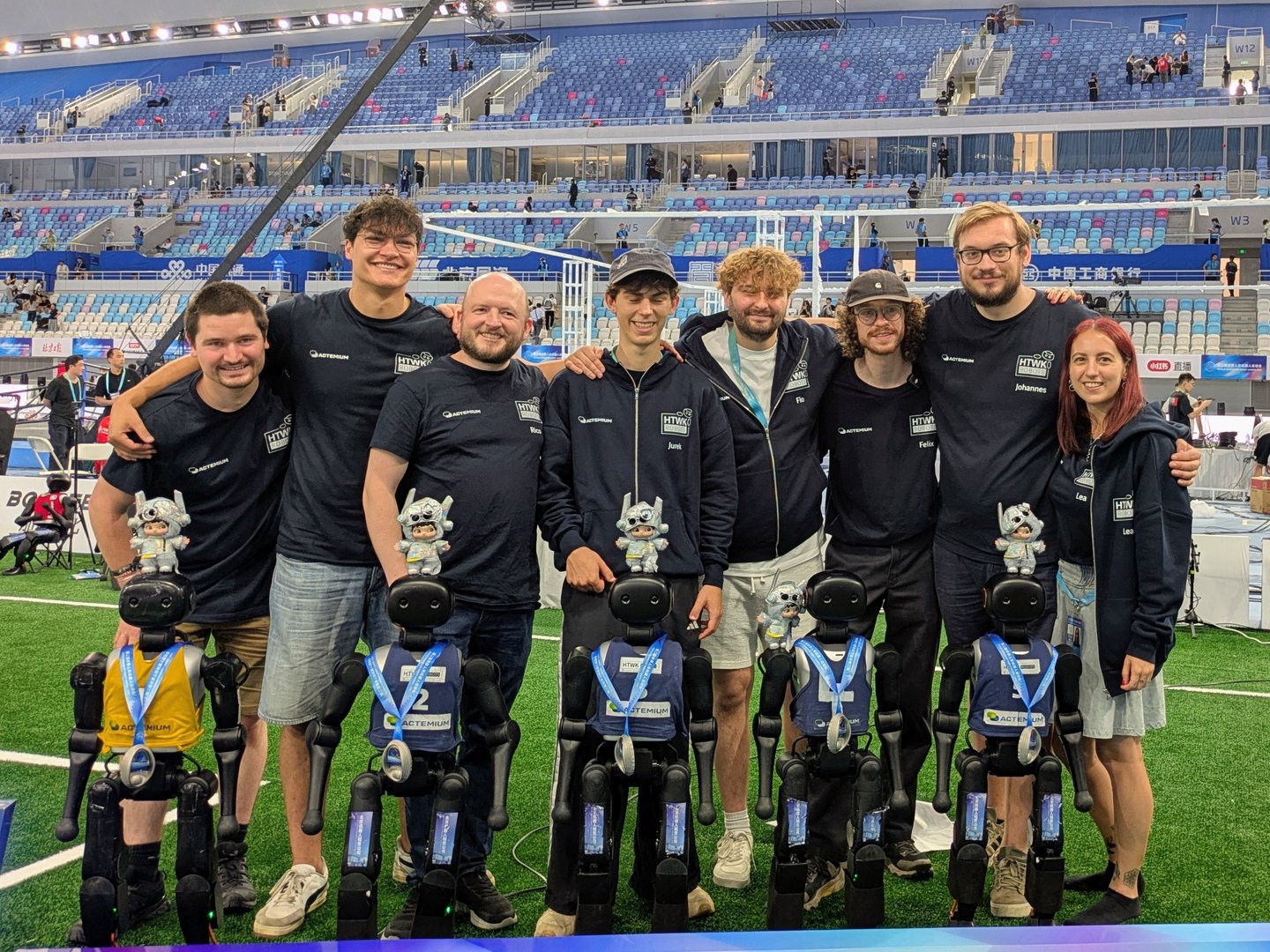
Shortly after finishing as runners-up at the RoboCup World Cup in South Korea, the HTWK football robots also secured silver in Beijing
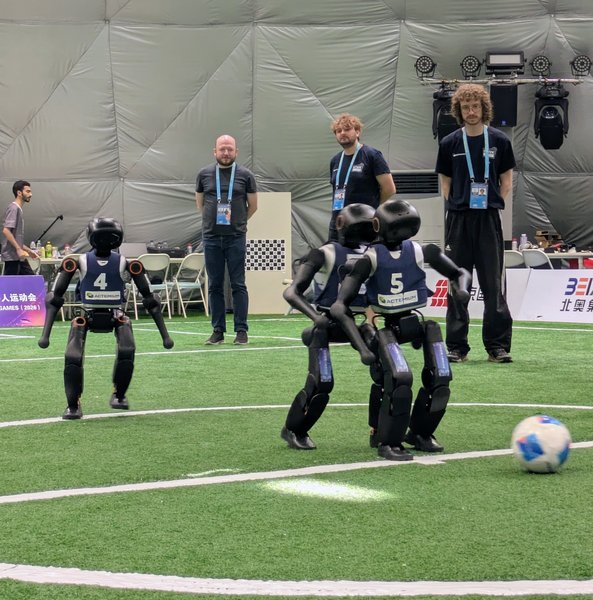
The robot football team ‘HTWK Robots’ from the Leipzig University of Applied Sciences (HTWK Leipzig) finished as runners-up at the ‘World Humanoid Robot Games’ held in Beijing from 22 to 26 August 2026, just as they didlast year. Whilst host nation China claimed victory at the inaugural ‘World Humanoid Robot Games’ in 2025, this time the team from B-Human in Bremen won 13–3. This team had already defeated the Leipzig side in July in South Korea in the final of this year’s RoboCup World Cup, meaning Leipzig had to relinquish its title.
“In the end, though, the final in Beijing against B-Human was actually more exciting than we’d expected. After all, we scored three goals! The long-range shots, which flew unstoppably into the net, were particularly helpful in that regard. We’re absolutely delighted with the result and can look back on some incredibly exciting days,” said Felix Loos of the HTWK Robots.
The two German teams have dominated world robot football in their class for years, and have consequently often faced each other in finals – yet off the pitch they are friends and maintain close contact.
In recent months, the Leipzig team had focused particularly on training movements such as shots, passes and running.
“Unlike in the past, behaviour is no longer programmed directly, but has been practised in simulation. This is done using various AI methods such as ‘reinforcement learning’ or ‘imitation learning’,” explains Tobias Jagla, a team member of the HTWK Robots.
Partnership with ‘Booster Robotics’
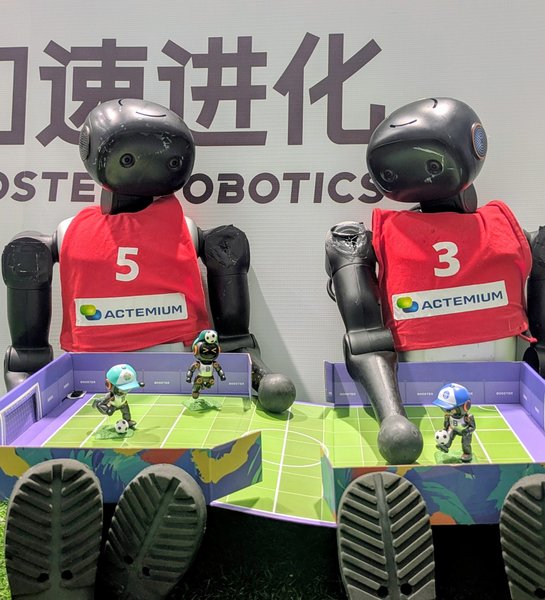
Since April 2025, the football-mad computer scientists at HTWK Leipzig have been working with the humanoid robots from the Chinese company Booster Robotics. The ‘Booster T1’ robots are larger than the Nao robots with which the team has been competing in international competitions since 2009. Since then, the HTWK robots have been among the world’s best in robot football: they were world champions in 2018 and 2025 and have been runners-up a total of nine times.
The Booster T1 robots, which are approximately 1.20 metres tall and weigh 30 kilograms, compete in the ‘Humanoid League Adult Size Division’. The HTWK Robots team ported the software originally programmed for the Nao robots onto the Boosters and, using artificial intelligence, taught them skills such as walking, dodging, navigating, standing up and scoring goals. In Beijing, the “Booster T2” model was also used. It is larger and heavier than the T1 and can run at speeds of over three metres per second.
“Within a very short space of time, the collaboration with Booster Robotics from China has enabled us to resolve a number of technological issues for which we were unable to find European partners. For us, this collaboration is both motivating and inspiring. The progress we have made in recent months is equivalent to several years’ worth of work. “I would like to thank the team and everyone who has supported us, especially Booster Robotics, for their passionate work,” said Jens Wagner, HTWK Professor of Mobile Robotics and one of the supervisors of the HTWK Robots.
Background: “World Humanoid Robot Games”
At the “World Humanoid Robot Games” in Beijing, more than 600 teams from 16 countries across six continents had gathered, with the vast majority – around 97 per cent – coming from China.
More than 2,000 humanoid robots competed against one another in 51 disciplines – not only in football, but also in the high jump, table tennis and dancing, amongst others. The robots can also sprint – Usain Bolt’s 100-metre world record of 9.58 seconds was broken. Service robots were also showcased.
The HTWK Robots
The HTWK team currently consists of 26 members, who are either studying at HTWK Leipzig or, as graduates, are already working. This research and the successful competition performances are made possible thanks to the support of various partners, including main sponsor Actemium and the Friends of HTWK Leipzig.
The stated aim of robot football is for football robots to defeat the reigning flesh-and-blood World Cup champions by 2050.
With their runner-up title in Beijing, the HTWK Robots are bringing a very successful summer to a close.
