
"I am convinced that the aim should be to train your students so that one day they have even better ideas and develop more elegant solutions than you do."
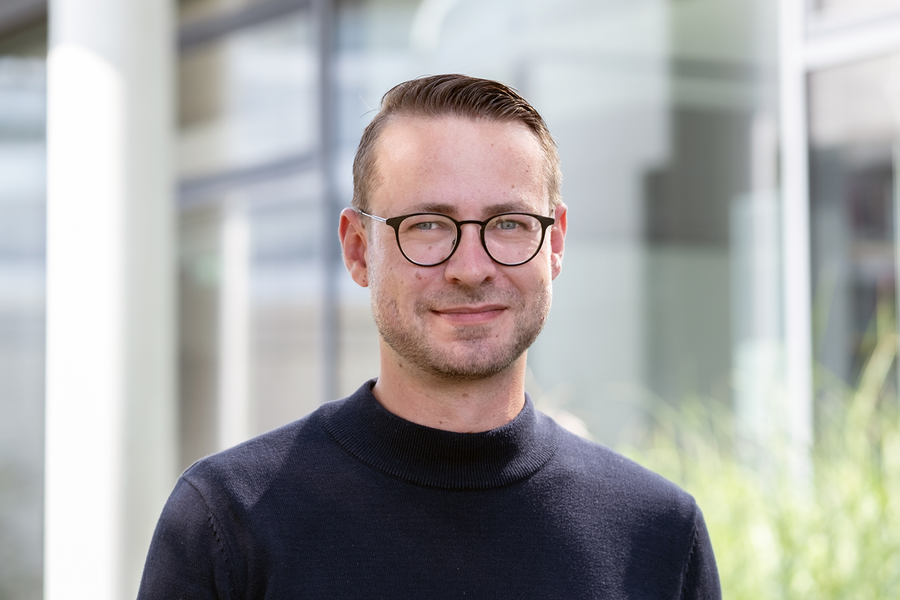
Editorial team: Congratulations on your appointment as Professor of Measurement and Sensor Technology at the Faculty of Engineering at HTWK Leipzig. Can you briefly explain the areas of responsibility associated with your professorship?
Prof Weise: My professorship for measurement and sensor technology encompasses both teaching and the further development of this key subject area within engineering education. A key part of my work is teaching the fundamentals and applications of measurement and sensor technology in the Bachelor's and Master's degree programmes. This currently includes the measurement technology and sensor technology and measurement systems modules in the Bachelor's programme and the sensor project in the Master's programme.
As I am also involved in teaching the fundamentals of electrical engineering and teach the modules Fundamentals of Electrical Engineering 1 and 2, I am particularly active in the undergraduate programme. Measurement technology is a central link here, as it combines basic electrical engineering content with practical applications.
I see it as my task to prepare students both methodically and practically for the diverse requirements of modern measurement and sensor technology and at the same time to further strengthen the link between basic teaching and application-orientated specialisation.
Editorial team: How did you decide to specialise in this area of research and teaching? Did you already know which path you wanted to take later on before you started your studies?
Prof Weise: I was lucky enough to get to know the university as a child. My father was a professor of communications and transmission technology at what was then the Leipzig University of Telecommunications (HfTL), and I occasionally visited him at his workplace after school - interestingly, in what is now the Trefftz building at HTWK. So in a way, I familiarised myself with the local premises early on.
Despite this family background, I wouldn't say that the path to a professorship is laid in your cradle. It's a long and arduous path with many predetermined breaking points.
After leaving school, I decided to study electrical engineering at the HTWK without having a clear idea of where this path would lead me. Initially, I was particularly interested in automation technology. During the course of my studies, however, I discovered medical engineering, which was part of the specialisation in "General Electrical Engineering" at the time. At the same time, my interest in the theoretical foundations of electrical engineering grew, so after my bachelor's degree I decided to continue my master's degree in theoretical electrical engineering at the TU Ilmenau. The change from applied sciences to theoretical electrical engineering was indeed very challenging. I still remember my first day of study with courses such as "Theoretical Electrical Engineering 2" and "Signals and Systems 2" without ever having heard the first parts at TU Ilmenau. They could have sent me to a Chinese university and I would have understood just as much. The familiarisation phase was correspondingly intensive, during which I spent a lot of time in the library and at home poring over books.
Looking back, however, this effort was worth it. I was able to complete my degree successfully and ultimately even with honours. I then completed my doctorate in 2016 at the TU Ilmenau in the field of theoretical electrical engineering. This was followed by several years in research, first as a postdoc at the Max Planck Institute for Human Cognitive and Brain Sciences in Leipzig and then at Aarhus University Hospital in Denmark. Finally, in 2023, I received a call from Prof Laukner at HTWK saying that they were urgently looking for a deputy professor for the fundamentals of electrical engineering - which fortunately led me to this interview.
Looking back, what has characterised my path is a deliberate openness in planning: I consciously only had the next step in mind - be it the decision to do a Master's degree, the subsequent doctorate or my further academic career as a postdoc. I refrained from planning too far in advance, as you can't predict the direction in which your own interests will develop, especially at the beginning of a degree programme.
It was also impossible to predict the limits of your own abilities and which external circumstances could influence your future path or even change it unexpectedly. Today, I walk through the same corridors with my children that my father once walked through with me. Perhaps you can imagine what a wonderful, homely and hopeful feeling that fills me with.
Editorial team: What skills and interests do you think students who decide to study electrical engineering and information technology should have?
Prof Weise: Choosing advanced courses in maths and physics can certainly make it easier to start studying. However, this advantage is relativised from the second semester at the latest, as the requirements become increasingly similar. In my opinion, the decisive factors are less specific prior knowledge and more curiosity, perseverance and a willingness to engage with challenging questions.
Nobody is born knowing how to convert Maxwell's equations from differential to integral form. Studying electrical engineering and information technology is to a large extent a process of learning. In my opinion, a structured and continuous way of working is the key to success - and ultimately also the basis for developing enjoyment in your studies.
In this context, a distinction between "joy" and "fun", which I learnt from my former physics teacher, is important to me. He said that joy comes at the end of an intensive day's work when you have understood, developed or researched something. Getting there involves effort. Fun, on the other hand, is more associated with ease and leisure. Especially when studying, it is worth discovering and appreciating this form of enjoyment in the subject and not confusing it with fun - it is a key driver for sustainable learning and intrinsic motivation.
Editorial team: What new projects would you like to realise in the future?
Prof Weise: Anyone who knows me knows that I'm not a fan of standing still. In recent years at the Max Planck Institute for Human Cognitive and Brain Sciences, I have worked intensively on issues relating to the modelling of brain functions. I am transferring this profile to measurement and sensor technology at the HTWK and have set myself the goal of further researching the human brain over the next few years in order to optimise a range of therapeutic approaches, among other things. This means that our measurement technology will inevitably take us into the operating theatre. As you can imagine, such projects involve a number of organisational and bureaucratic hurdles in addition to the engineering issues. Such projects require a great deal of perseverance and can only be managed by an interdisciplinary team. For this reason, I am looking forward to working on these issues over the next few years with the team at the Department of Neurosurgery at Leipzig University Hospital and especially PD Dr Florian Wilhelmy.
There may be thinner planks to drill and simpler measurement tasks to solve, but true progress always involves a certain amount of effort. I would like to encourage my students to see big challenges as opportunities and to tackle them with courage and confidence.
I am convinced that it should be the goal of every university teacher to educate their students so that one day they will have even better ideas and develop more elegant solutions than you. For me, teaching is not just about imparting knowledge, but also about shaping mindsets, encouraging curiosity and developing the courage to go your own way. As professors, we are the role models who show that hard work and learning will pay off one day. After all, we are what our students will one day outgrow.
