
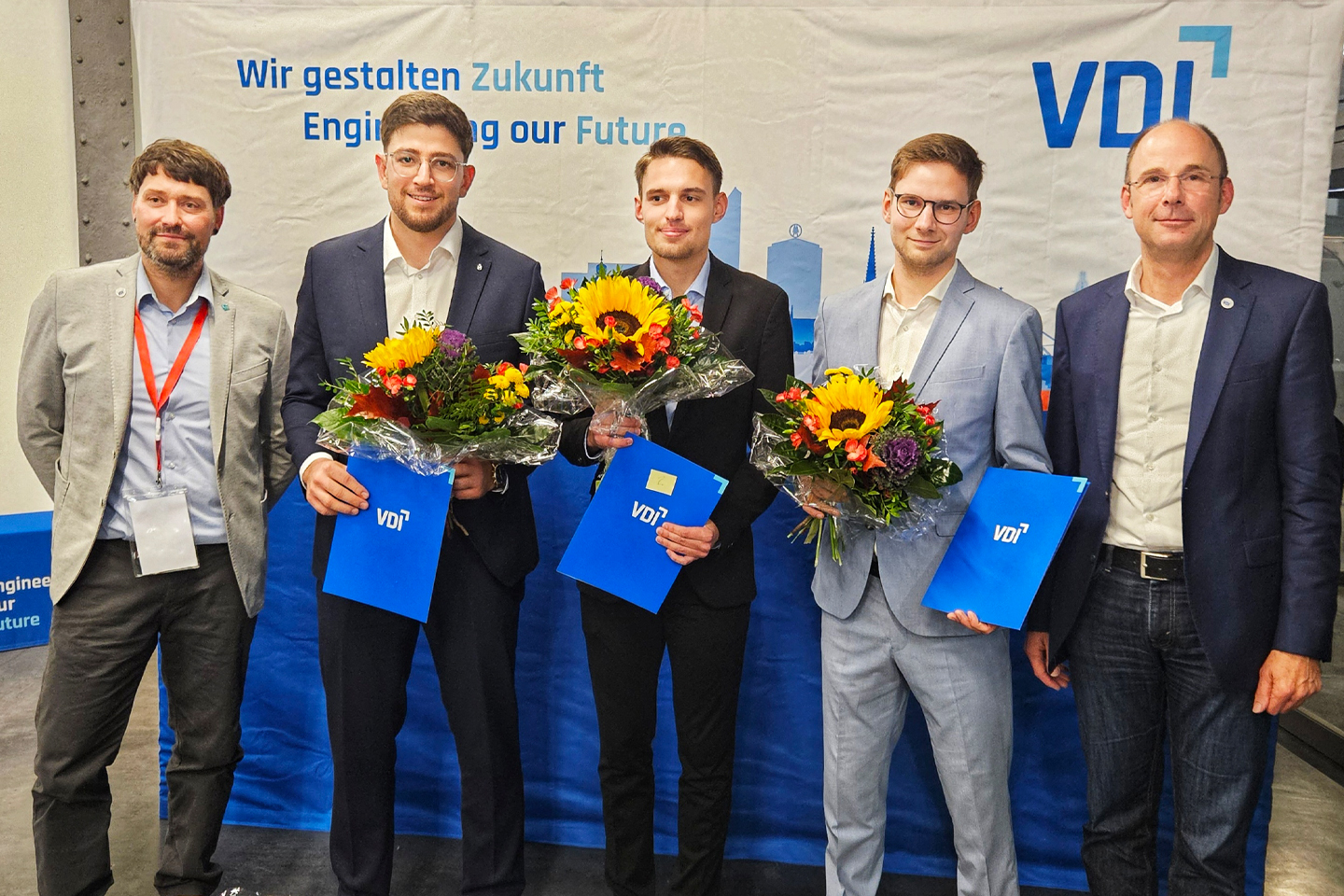
The 2026 prize winners are Jonny Menzel, MSc (1st place), Richard Mende, BEng (2nd place) and Karl Marbach, MEng (3rd place).
On 30 October 2026, during the general meeting of the VDI Leipzig District Association, graduates from the Faculty of Engineering at HTWK Leipzig were awarded the 2026 VDI Sponsorship Prizes for their outstanding final-year projects.
The VDI Encouragement Award
The Leipzig Branch of the Association of German Engineers (VDI) awards the VDI Encouragement Prize annually for outstanding achievements in the field of engineering. Each year, students may apply with their engineering dissertation, whilst school pupils may apply with a project in the field of engineering. The prize is awarded primarily to projects that are characterised by a distinctly innovative nature, interdisciplinarity and a focus on economic efficiency.
The prize winners
1st Prize: M.Sc. Jonny Menzel | Master’s thesis on the cost-effective calculation of electromagnetic excitation and the resulting vibration behaviour in large drives
For his Master’s thesis entitled ‘Design of an automated method for calculating the electromagnetic excitation and the resulting vibration response of ring motors using open-source simulation software’, Jonny Menzel, an M. Sc. Jonny Menzel was awarded the VDI Support Association’s 1st Prize.
The thesis was supervised by Prof. Dr.-Ing. Cornelius Bode (Chair of Electrical Machines). The Master’s thesis was produced in collaboration with Innomotics GmbH (Dynamowerk Berlin), a world-leading manufacturer of large-scale electric drives.
In his thesis, Jonny Menzel examines the mathematical prediction of the exciting electromagnetic forces and the resulting mechanical vibrations to be expected during operation of large electric drives. These calculations are an essential part of the quotation and order processing for such large drives and are becoming increasingly important. As large-scale drives are generally bespoke solutions, it is usually necessary to recalculate the vibration behaviour for each order, which involves a considerable amount of time and is therefore costly. As part of his work, Jonny Menzel has therefore designed and prototyped an automated calculation process that automatically calculates the electromagnetic excitation of synchronous ring motors and the resulting mechanical vibrations.
The exceptional practical relevance of this work stems primarily from two factors:
- The user only needs to specify a few parameters, meaning that the calculation can be carried out easily even by non-experts.
- The software developed utilises open-source software for the calculations, meaning there are no costs associated with licensed FEM software.
2nd Prize: B.Eng. Richard Mende | Bachelor’s thesis on the implementation of a tool for automated PID controller parameterisation for compressor and turbine systems
B.Eng. graduate Richard Mende was awarded second prize by the VDI Support Association for his Bachelor’s thesis ‘Implementation of a tool for automated PID controller parameterisation for compressor and turbine systems’ in the field of Electrical Engineering and Information Technology.
The thesis was supervised by Prof. Dr.-Ing. Hendrik Richter (Chair of Control Engineering). The Bachelor’s thesis was carried out in collaboration with Avicomp Controls GmbH, a medium-sized technology company based in Leipzig whose core competence lies in automation solutions for rotating machinery, in particular compressor and turbine systems.
In addition to plant engineering, the company specialises in the digitalisation of the process chain, particularly in what is known as the ‘digital twin’. In automation technology, a digital twin is a central element of modern, applied digitalisation. It represents the rotating machine or plant in digital form throughout the entire process chain – from planning through to operation and maintenance. A digital twin contributes significantly to increasing transparency, efficiency, reliability and innovation capacity, and is therefore an essential component of modern digitalisation concepts.
In his Bachelor’s thesis, Richard Mende developed a solution that forms a further building block of the digital twin and delivers direct industrial benefits, as it can be transferred into the implementation maintained by Avicomp. Richard Mende is now working as a student trainee at Avicomp alongside his current Master’s degree at the HTWK, where he is dedicated to the further development and integration of the solution he devised. The results achieved in his Bachelor’s thesis thus have a direct and immediate practical impact.
3rd Prize: M.Eng. Karl Marbach | Master’s thesis on budget-optimised production programme planning at the press shop of the BMW plant in Leipzig
Graduate M.Eng. Karl Marbach received the VDI Support Association’s 3rd Prize for his Master’s thesis entitled ‘Development and implementation of an approach to budget-optimised production programme planning in the press shop at the BMW plant in Leipzig’.
The thesis was supervised by Prof. Dr. rer. nat. Martin Gürtler (Chair of Production and Logistics Systems). The Master’s thesis was carried out in collaboration with the BMW Group at its Leipzig site.
At the BMW Group’s vehicle plant in Leipzig, the planned integration of new vehicle variants from mid-2026 onwards will lead to a calculated space over-allocation of more than 15 per cent, particularly in the press shop and body shop areas. Under the existing production logistics procedures, the internal storage of all circulating and intermediate stock is therefore no longer feasible. Against this backdrop, there is an urgent need for action to actively address the conflict of objectives between production and logistics efficiency. To this end, this thesis identifies relevant decision-making parameters affecting costs and performance and aggregates them using various combinatorial optimisation models in order to develop well-founded, data- and model-based decision support tools.
As part of his Master’s thesis, Karl Marbach demonstrated significant reductions in external transport movements of up to 60 per cent, as well as increases in the proportion of value-adding time for the capital- and labour-intensive large presses. The latter result from an increase in the average order processing time of around 15 per cent. Furthermore, optimising order control in door production achieves a reduction in maximum stock levels of over 25 per cent, whilst simultaneously increasing the average range of the work systems under consideration by more than 29 per cent. In total, the resulting annual savings potential amounts to a high six-figure sum in euros. Against this background, the models developed should be seen as key enablers for the sustainable reduction of costs per vehicle and for strengthening the site’s competitiveness.
Congratulations
The Faculty of Engineering and the supervising professors congratulate all three prize winners and wish them every success in their future careers.
