
Prize winners 2025: M. Eng. Fabian Duckhorn (1st place), B. Eng. Luca David Kukuk (2nd place), M. Eng. Jan Bertram (3rd place)
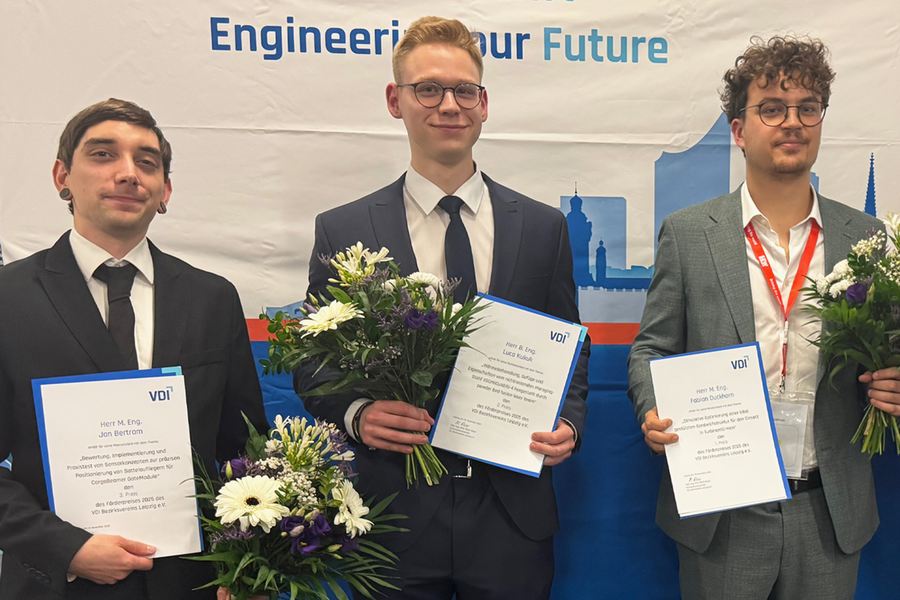
On 14 November 2025, the graduates of the Faculty of Engineering at HTWK Leipzig Fabian Duckhorn, Luca David Kukuk and Jan Bertram received the VDI Sponsorship Awards 2025 for their outstanding theses at the general meeting of the VDI District Association Leipzig e.V.
VDI Sponsorship Award
The Verein Deutscher Ingenieure (VDI) Bezirksverein Leipzig e.V. awards the VDI Sponsorship Prize annually for outstanding achievements in the field of engineering. Every year, students can apply with their engineering thesis and school pupils with a work in the field of engineering. The prize is awarded above all to work that is characterised by a distinctly innovative character, interdisciplinarity and the idea of economic efficiency.
1st prize | Master's thesis on innovative lightweight structures in wind turbines
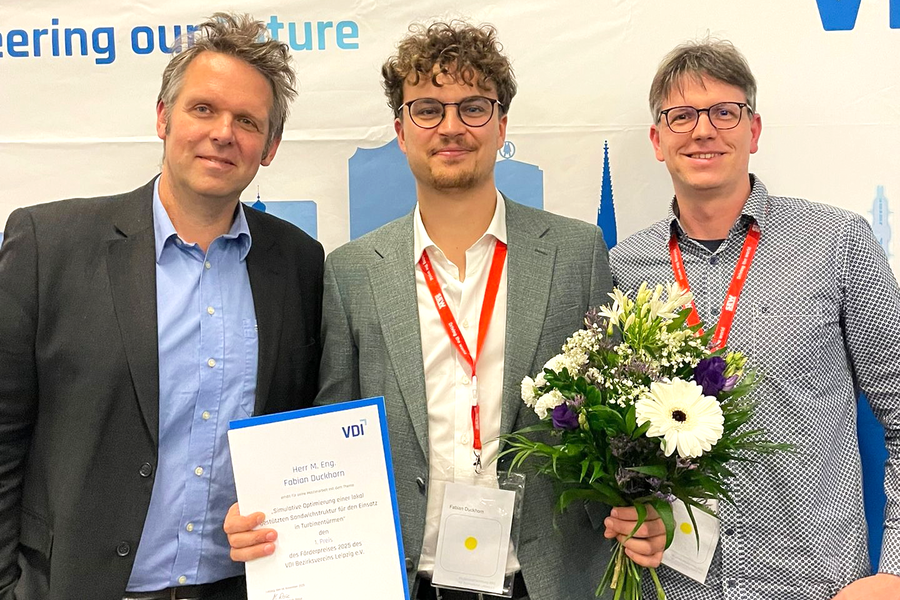
The 1st prize went to graduate M. Eng. Fabian Duckhorn for his master's thesis"Simulative optimisation of a locally supported sandwich structure for use in turbine towers". The thesis was supervised by Prof. Robert Böhm, Chair of Lightweight Construction with Composite Materials at HTWK Leipzig and Dipl.-Ing. Markus Grünert from beventum GmbH.
In his master's thesis, Duckhorn investigated the innovative lightweight construction concept of the NECTO sandwich structure and its use in wind turbines.
The utilisation of high-altitude wind is a promising option for generating energy with wind turbines in order to increase the efficiency of the turbines. Due to the growing demands on turbine towers in terms of height and stability, innovative lightweight construction concepts are becoming increasingly important. In his thesis, graduate Fabian Duckhorn is investigating the suitability of the NECTO sandwich structure for use in turbine towers with a sandwich construction. To do this, he uses a metamodel-based optimisation approach to maximise the load-bearing capacity and minimise the weight. In his study, he also integrates a multi-scale approach, i.e. the stress on the tower wall under design loads of the tower head is determined with analytical calculations on the macro level and the buckling behaviour of the sandwich structure is evaluated with meso-scale finite element simulations. An artificial neural network in the form of a radial basis functions network is trained to efficiently approximate the non-linear structural behaviour. Based on this, a multi-criteria optimisation using the Non-dominated Sorting Genetic Algorithm II is performed to explore design trade-offs. The work results in increasing the critical buckling force of the structure by 480 per cent while maintaining the same weight. However, it turns out that there are no solutions in the analysed design space that can transfer the high loads of the tower wall. Further investigations are therefore required. Supervisor Prof. Böhm emphasises that the optimisation model developed in the thesis represents a sound basis for the parameterised investigation of the NECTO structure and can be extended to include further load cases.
2nd prize | Bachelor's thesis on the material characterisation of additively manufactured stainless steel
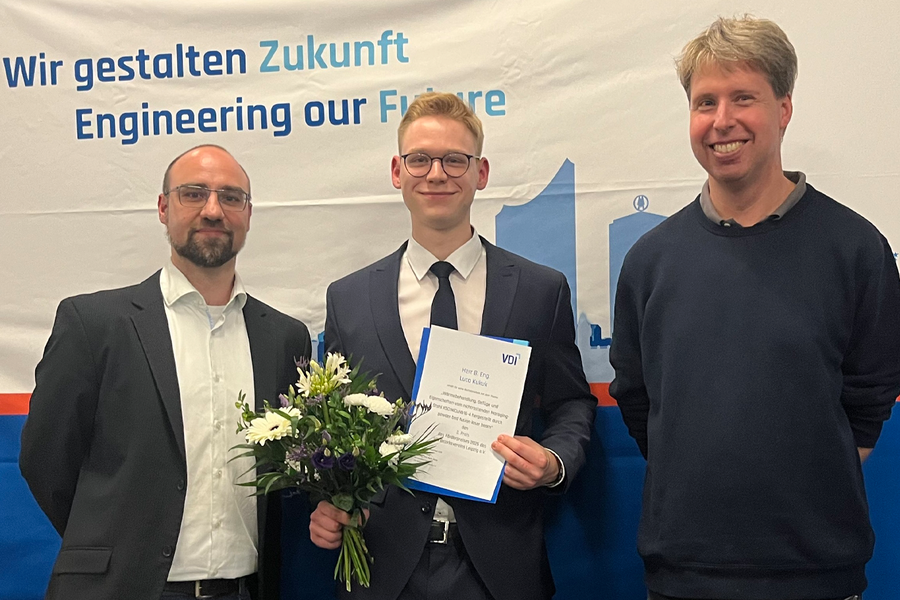
The 2nd prize went to B. Eng. Luca David Kukuk for his bachelor's thesis entitled "Heat treatment, microstructure and properties of stainless maraging steel X5CrNiCuNb16-4 produced by powder bed fusion laser beam".
The bachelor's thesis was supervised by Prof Paul Rosemann, Chair of Materials Engineering at HTWK Leipzig, and was written in close cooperation with Hans-Werner Theobald from 3D-Metall Theobald in Leipzig.
In his bachelor's thesis, Luca David Kukuk analysed the complex relationship between the additive manufacturing of components made from steel powder, the microstructure, which depends on the manufacturing process and the subsequent heat treatment, as well as the resulting material properties. Graduate Kukuk analysed this complex microstructure-property relationship through systematic investigations using various methods of experimental materials research.
In his thesis, Kukuk compared the mechanical properties of maraging steel with the austenitic steel previously used and worked out and quantitatively described the advantages, such as three times the strength and twice the hardness. He also systematically analysed the necessary heat treatment parameters as part of his work, so that components can be produced with consistently high quality and property profiles adapted to the application.
By analysing the toughness in the notched bar impact test and the fracture surfaces produced in the scanning electron microscope, it was also possible to demonstrate the fracture resistance under multi-axial stress conditions and impact loading. Using the maraging steel X5CrNiCuNb16-4, this makes it possible to open up further areas of application for the additive manufacturing of steel.
In addition, Kukuk analysed the corrosion resistance of the additively manufactured steels and compared the results with conventionally manufactured steel. The results were used to demonstrate the advantages of additive manufacturing using powder bed fusion laser beams in terms of corrosion resistance.
The findings of Luca David Kukuk's award-winning bachelor's thesis will help the cooperation partner 3D-Metall Theobald with the heat treatment and marketing of its components 3D-printed from steel powder and will therefore be used directly in the local industry in Leipzig. In addition, the scientific publication of the results is planned for next year.
3rd prize | Master's thesis on the optimisation of intermodal freight transport
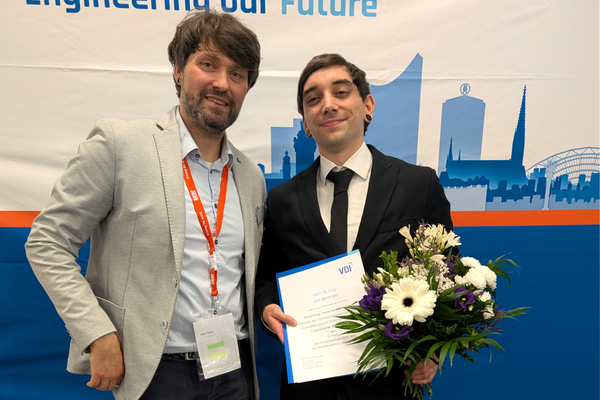
M. Eng. Jan Bertram was awarded 3rd prize on 14 November 2025 for his Master's thesis"Evaluation, implementation and practical testing of sensor concepts for the precise positioning of semi-trailers for CargoBeamer GateModules". The thesis was supervised by Prof Mathias Rudolph, Chair of Industrial Metrology.
Jan Bertram's Master's thesis is dedicated to automated positioning systems designed to improve the process of intermodal freight transport. Increasing freight transport and CO₂ emissions in road transport need to be managed efficiently and sustainably in today's logistics. Intermodal freight transport offers a solution here, but its efficiency is limited by the time-consuming manual transfer of semi-trailers to rail.
At the CargoBeamer terminal in Calais, the handling of semi-trailers is highly automated, but the current positioning of the semi-trailers is based on an imprecise, manual measuring process with a measuring rod, which is prone to errors, requires readjustments and ties up additional personnel. In his master's thesis, Bertram is developing two measuring systems for the CargoBeamer terminal that will fully automate this process and enable positioning by the vehicle driver alone.
Based on existing sensor studies, he designed two systems: a compact, economical ultrasound system and a robust RFID approach with Siemens components. Following technical planning, construction of the necessary brackets and creation of electrical circuit diagrams, both systems were installed and calibrated at the terminal in Calais. Finally, two series of measurements were recorded in field tests under real conditions.
The results of the series of measurements show that the RFID system is superior: it enables a more stable, more intuitive position display and facilitates vehicle guidance thanks to less erratic changes in measured values. With increasing use, the drivers' operating skills and positioning accuracy also improved. The RFID system is therefore recommended for practical use.
The Faculty of Engineering and the professorial supervisors congratulate all three prizewinners and wish them every success for their future careers.
