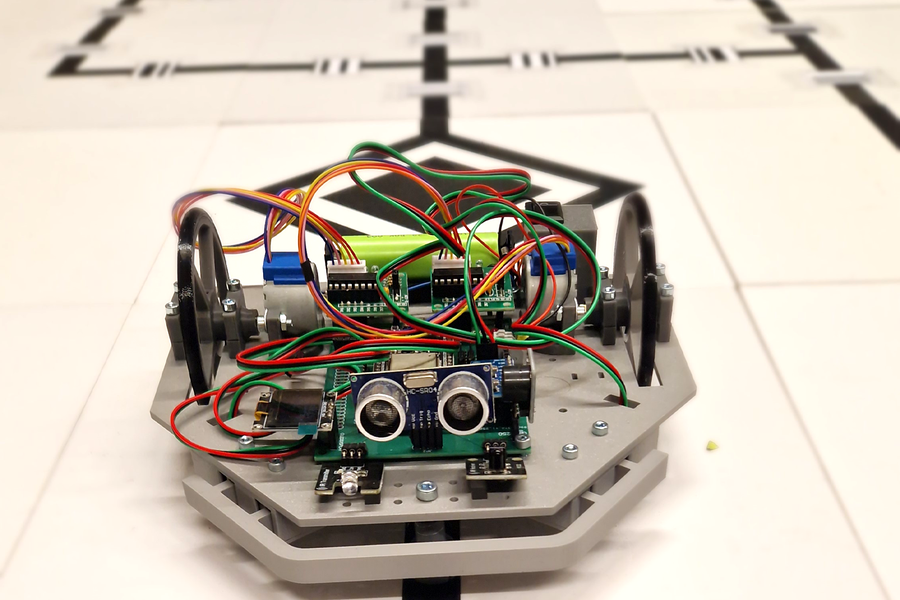
The platform was developed by the LeoBots student team and the RoboCreators educational project of the Faculty of Engineering at HTWK Leipzig.
Practical STEM education for schools
With a newly developed, completely open and cost-effective robot platform, HTWK Leipzig is bringing hands-on STEM education directly into the region's classrooms. The small, mobile platform was specially designed for teaching purposes and can be manufactured for around 50 euros. It supports ROS (Robot Operating System), is completely open source and is ideal for use in schools. With the open robot platform, schools can carry out practical STEM teaching units - from initial programming exercises and sensor experiments to robotics and ROS workshops in which pupils develop and test their own autonomous driving functions. As the chassis is fully 3D printable and the associated circuit board can be soldered independently, the robot platform also promotes manual skills, technical understanding and the use of manufacturing technologies.
The developers RoboCreators & LeoBots
The platform was developed by the LeoBots student team and the RoboCreators educational project of the Faculty of Engineering at HTWK Leipzig. RoboCreators is supported by the skilled labour alliances of the city of Leipzig, the district of North Saxony and the district of Leipzig. Their aim is to sustainably strengthen STEM education in the schools of these three regions and to support pupils and teachers alike.
The workshops
Numerous workshops are offered as part of the project - from 3D printing, robotics, programming and machine learning to a popular soldering workshop. Participants make small electronic kits that are designed according to the main theme, motto, season or event. At Christmas time, for example, they create glowing mini Christmas trees that the pupils can take home with them.
The robotics workshop teaches the basics of robotics and programming, while the 3D printing workshop introduces pupils to design processes and enables them to develop their own models and then print them out. A key component of the project is the LeoBots student group, consisting of 10 to 15 students from the Faculty of Engineering in the field of electrical engineering. The LeoBots develop technical devices, robot models and supporting learning materials - including the new robot platform, which is intended to provide pupils with a particularly low-threshold introduction to robotics, computer science and programming in the future.
Last year, the RoboCreators project reached around 3,000 pupils and almost 100 teachers - impressive proof of the high demand for practical STEM education in the region.
The new robot platform is set to become a central element of the workshops in future and will enable schools to realise their own robotics projects in a cost-effective and sustainable way.
Link to the robot platform project: https://github.com/RoboCreators/HTWK_ROS_MiniRoboter