
Martin Meister, a student at MIT (Cambridge, USA), spent eleven weeks at the Faculty of Engineering in the summer of 2026, during which time he got to know two research groups and their laboratories.
Eleven weeks, two laboratories, two research topics
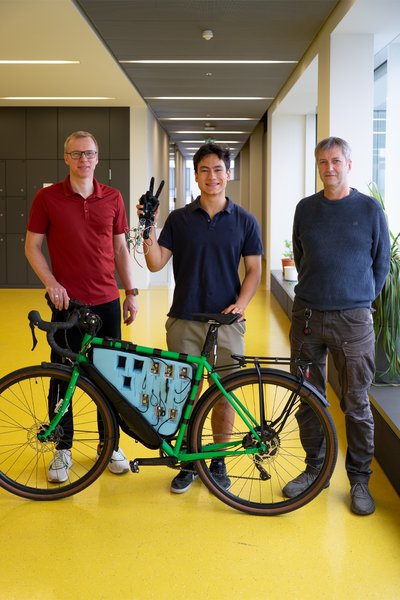
From June to August 2026, Martin Meister, an electrical engineering student at the Massachusetts Institute of Technology (MIT) in Cambridge (USA), was a visiting student at the Faculty of Engineering at HTWK Leipzig. His placement was arranged through MISTI Germany, the German branch of MIT International Science and Technology Initiatives. Every year, between 80 and 100 MIT students work on practical projects with partners in Germany through the programme.
His eleven weeks at HTWK Leipzig were deliberately split between two research groups: Prof. Martin Gürtler’s prodlog research group and Prof. Stephan Schönfelder’s bikelab. This enabled Martin Meister to familiarise himself with a wide variety of research topics, working methods and laboratories. In both groups, he worked closely with undergraduates and PhD students at HTWK Leipzig.
Martin Meister on his visit to Leipzig:“I had a great time working in the two labs and immersing myself in German culture. Leipzig is a lovely city to live in as a student, and I would definitely recommend other US students come here to visit or study!”
When robots learn to use their fingertips
Prof. Gürtler’s Research Group | Development of a compact tactile sensor for robots
How can robots tell how firmly they are gripping an object, or whether it is slipping out of their hand? Prof. Gürtler’s prodlog research group is investigating this question. The focus is on a soft magnetic sensor structure based on the so-called ‘e-Flesh’ principle: small magnets are embedded in a 3D-printed, flexible structure. When touched or deformed, the magnetic field changes – from which force and deformation can be deduced.
Together with Eric Plaß, Martin Meister worked on the miniaturisation and technical integration of the sensor. He developed a small printed circuit board (PCB) that compactly integrates the necessary electronics; a functional prototype is now available. The sensor structure and electronics are thus so small that the sensor fits into a finger of the robotic hand.
At the same time, an automated calibration pipeline was developed: a simple, partly 3D-printed robotic arm systematically scans the sensor’s surface. Using the data obtained, the magnetic measurements are mapped to physical quantities such as force and deformation with the aid of machine learning. With the PCB prototype, its integration into the robot finger and the resource-efficient calibration method, the research group now has an important foundation for the further development of tactile robotic systems.
When the bike is part of the measurement
Prof. Schönfelder’s Research Group | Load measurement on the test bike in the bikelab
What forces act on a bicycle as it rolls over an obstacle? Prof. Schönfelder’s research group at the bikelab is investigating this question. During the second part of his work placement, Martin Meister worked there on a test bike: Strain gauges on the seat post and stem record the loads acting on these components during real-world riding. In the long term, this should enable comparisons to be made between different riding situations, such as riding on flat ground and riding over an obstacle.
Together with student assistant Tilman Walter, Martin Meister tested the measurement system on several test rides. He expanded the microcontrollers’ firmware to include error messages, so that problems in the measurement chain can be detected more quickly, and wrote Python scripts that allow the recorded measurement data to be analysed and displayed graphically. He also worked on integrating additional acceleration sensors into the system.
The test runs revealed where the measurement chain still needs improvement – a valuable insight for the next steps. With the enhanced firmware, the analysis scripts and the experience gained from the test runs, Martin Meister has laid an important foundation for the upcoming measurement runs at the bikelab.
Cooperation with MIT continues
Martin Meister’s visit follows in a tradition that began in 2016: back then, through the contacts of Prof. Stephan Schönfelder, two MIT students came to HTWK Leipzig for the first time for ten weeks – and even then they were involved in two different research projects. Since then, students from Massachusetts have repeatedly come to Leipzig for summer placements. This benefits both sides – the visiting students as well as the students and researchers at HTWK, who gain international experience as part of their day-to-day laboratory work. The collaboration is set to continue in the coming years.
