HTWK Leipzig was also represented at the Saxon Transfer Forum organised by futureSAX in November 2026 – A review
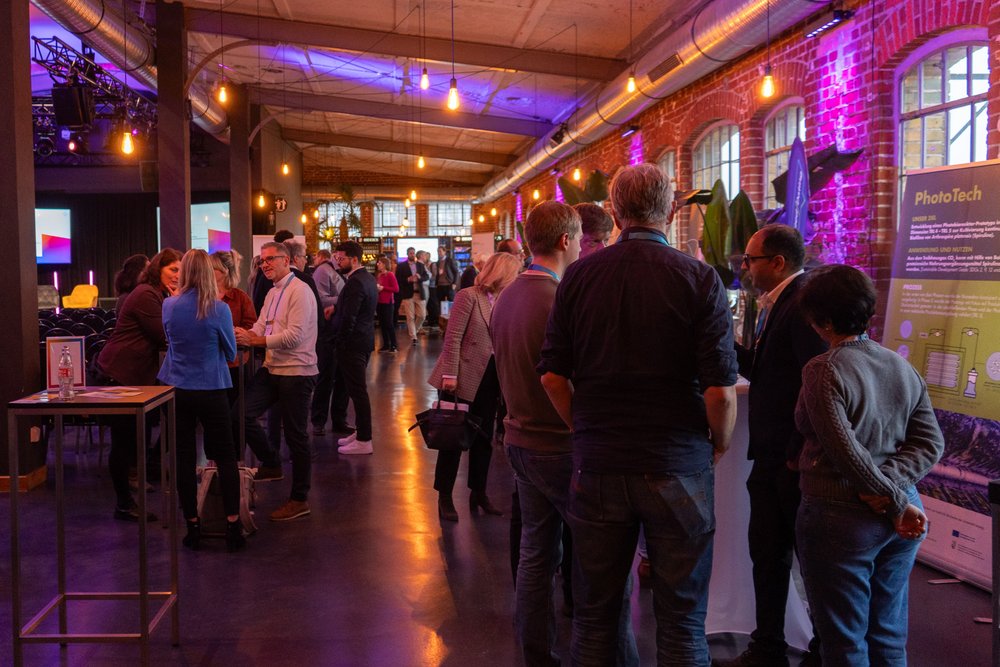
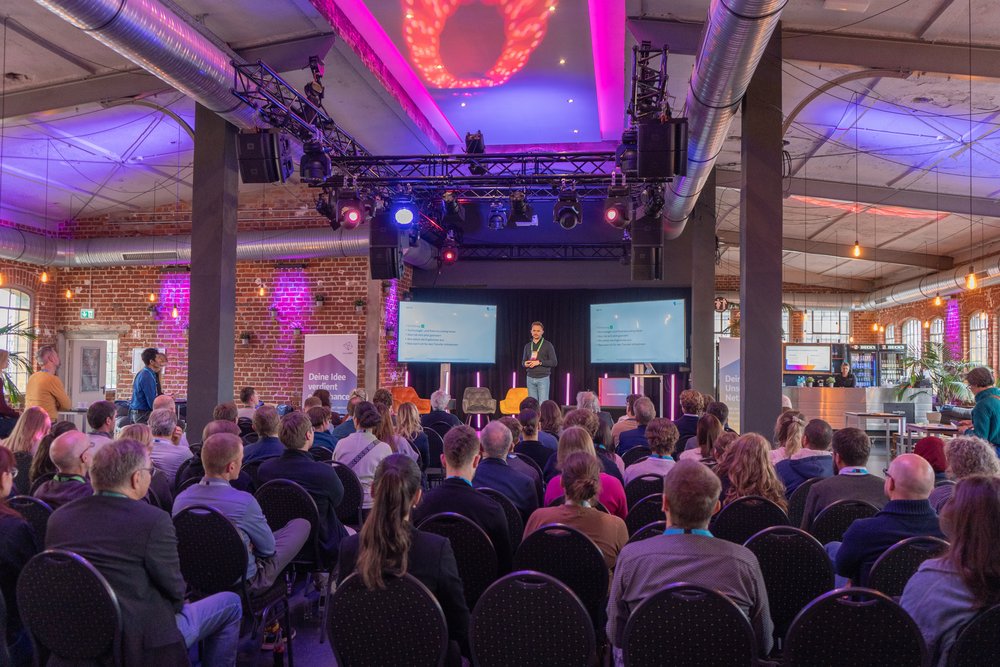
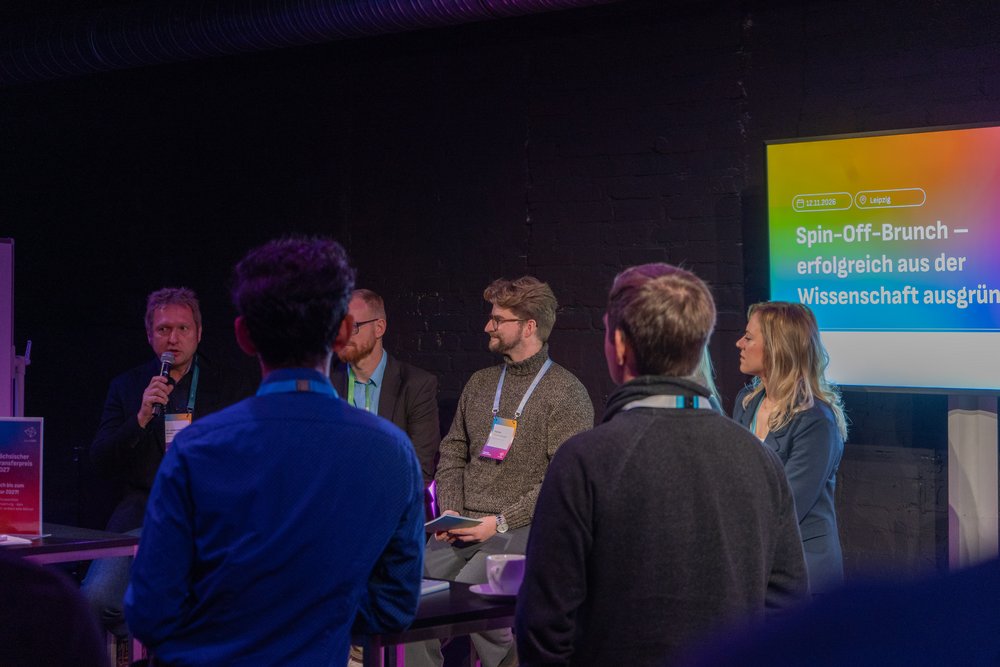
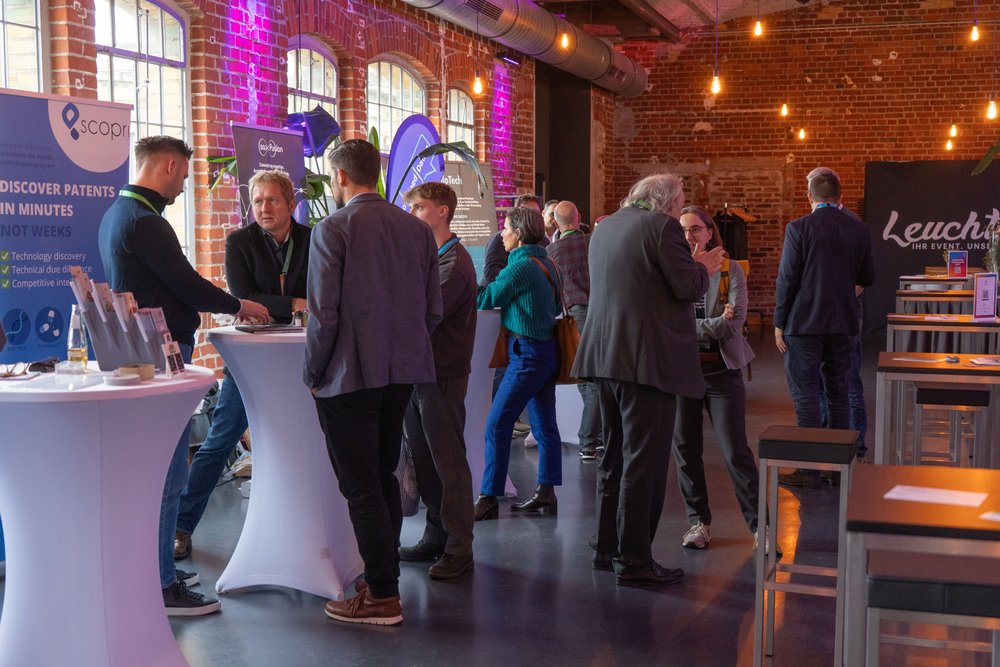
To ensure that research findings can be rapidly translated into practical applications, there needs to be an active process of knowledge and technology transfer. But what methods are available for fostering collaboration between academia and industry, and what are the key considerations when setting up a spin-off? Researchers from various institutions and experts from the business sector were able to exchange views on these topics at the Saxon Transfer Forum organised by futureSAX. More than 100 participants gathered on 12 November 2026 at the Leuchtenbau event venue in Leipzig-Engelsdorf for this exchange event organised by the Free State of Saxony’s innovation platform. Researchers from HTWK Leipzig were also in attendance and took part in the accompanying exhibition.
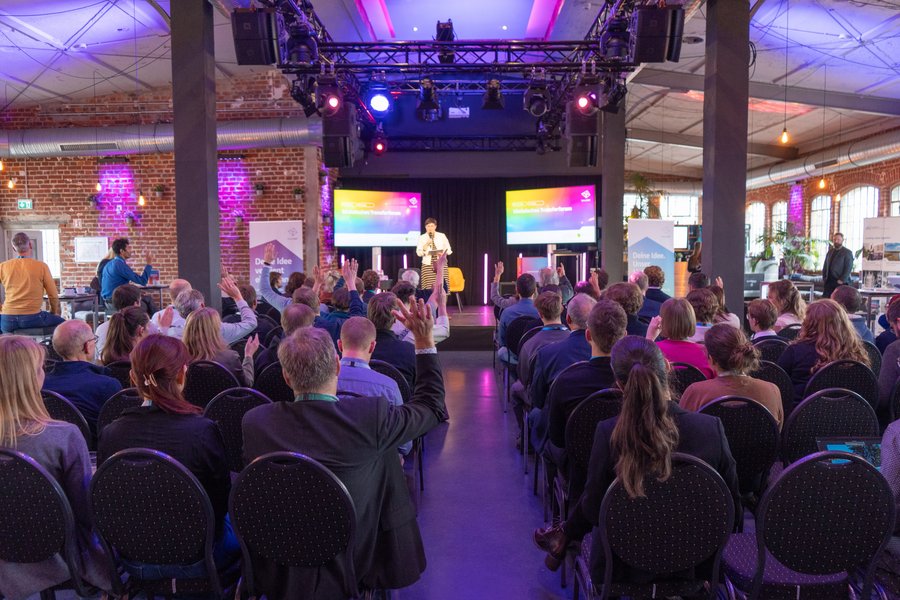
The participants in the Saxon Transfer Community were welcomed by Heinrich Hünting, Head of the Department for Economy, Innovation and SMEs at the Saxon State Ministry for Economic Affairs, Labour, Energy and Climate Protection, and by Susanne Stump, Managing Director of futureSAX. Following the keynote speech by Mateo Primorac, Co-Founder & CEO of scoprixai FlexCo, on ‘The Future of Technology and Patent Scouting’, a series of sessions took place. One session focused on contracts relating to intellectual property rights, another on contract research in the skilled trades, and a further session presented a Ready-to-Transfer Box, which offered tried-and-tested methods and materials to help organise technology transfer in a structured, practical and impact-oriented manner. There was also plenty of opportunity for networking, including at the InnoSpeedDating event, as well as in the exhibition area itself.
Using wind turbine blades as building facades

On behalf of the ‘Composite Circularity Lab’ (CCL) research group at HTWK Leipzig, architect Dr Pamela Voigt presented various façade systems in the exhibition area. The demonstrators were created by students in the final design seminar on climate-friendly building construction during the summer term of 2026, using decommissioned wind turbine rotor blades. The demonstrators, featuring plug-in and press-fit joints, slatted structures and shading systems, are just a few examples of how this high-performance composite material can be reused after its initial use. The research group itself has already used it to produce, for example, a bench, a floating raft, an outdoor kitchen and a cargo bike.
However, the researchers at the CCL are not only looking into the recyclability of old rotor blades; the manufacture and mass production of products made from reused rotor blade materials is also on the CCL’s agenda, which is why they are also considering setting up a start-up. “The old rotor blades offer great potential with a wide range of applications in the construction industry. Components such as panels, webs and slats, beams, columns and strips could be used to create load-bearing frames, shells, concave troughs and usable cavities,” says Voigt.

Research prospects for SMEs in the construction sector
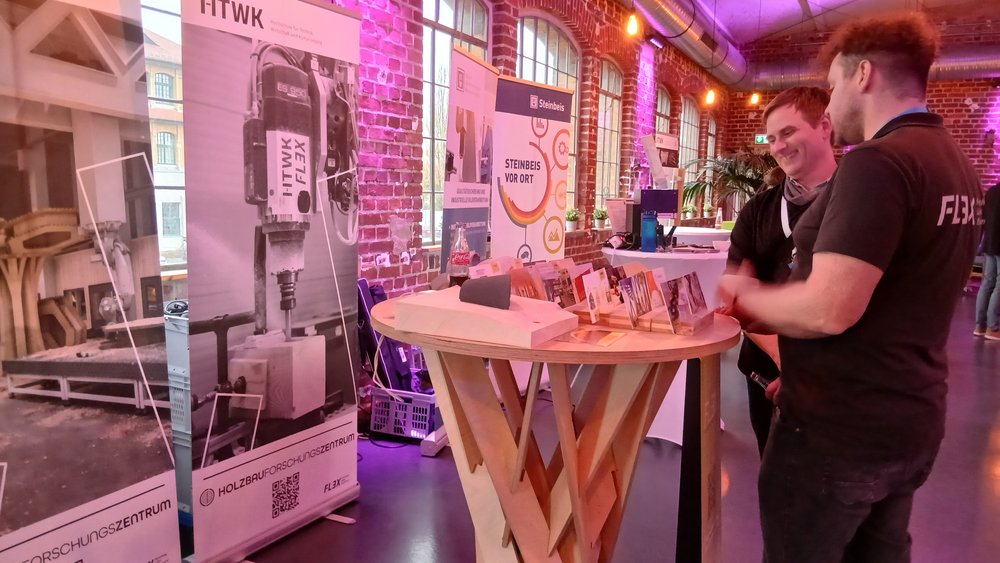
At another stand, Martin Dembski, founding member and technical director of theFLEX Institute for Research, Teaching and Experimentation at HTWK Leipzig, presented current research topics in the field of digitalisation in the construction industry. These included projects such as ARsist and OptiPaRef on augmented reality in the skilled trades, TimberBot on the use of robotics in the skilled trades, TimberWallDesAIgn on the use of AI in planning, and ReFoRe on the recycling of timber from demolition projects. Transfer projects and platforms such as Saxony5, the Wandelbogen, the Pfalzturm and EASTWOOD were also presented. In addition to these, particular emphasis was placed on the potential of the university’s Wood Construction Research Centre as a practical research and transfer real-world laboratory featuring the new hybrid robotic crane platform HỊDRA, and as a space and point of contact for the implementation of innovative ideas for small and medium-sized enterprises (SMEs) in the construction industry.
More photos